The 2011 Brisbane Floods: What Every Buyer Needs to Know Before Purchasing in a Flood Zone
Published 20 March 2026
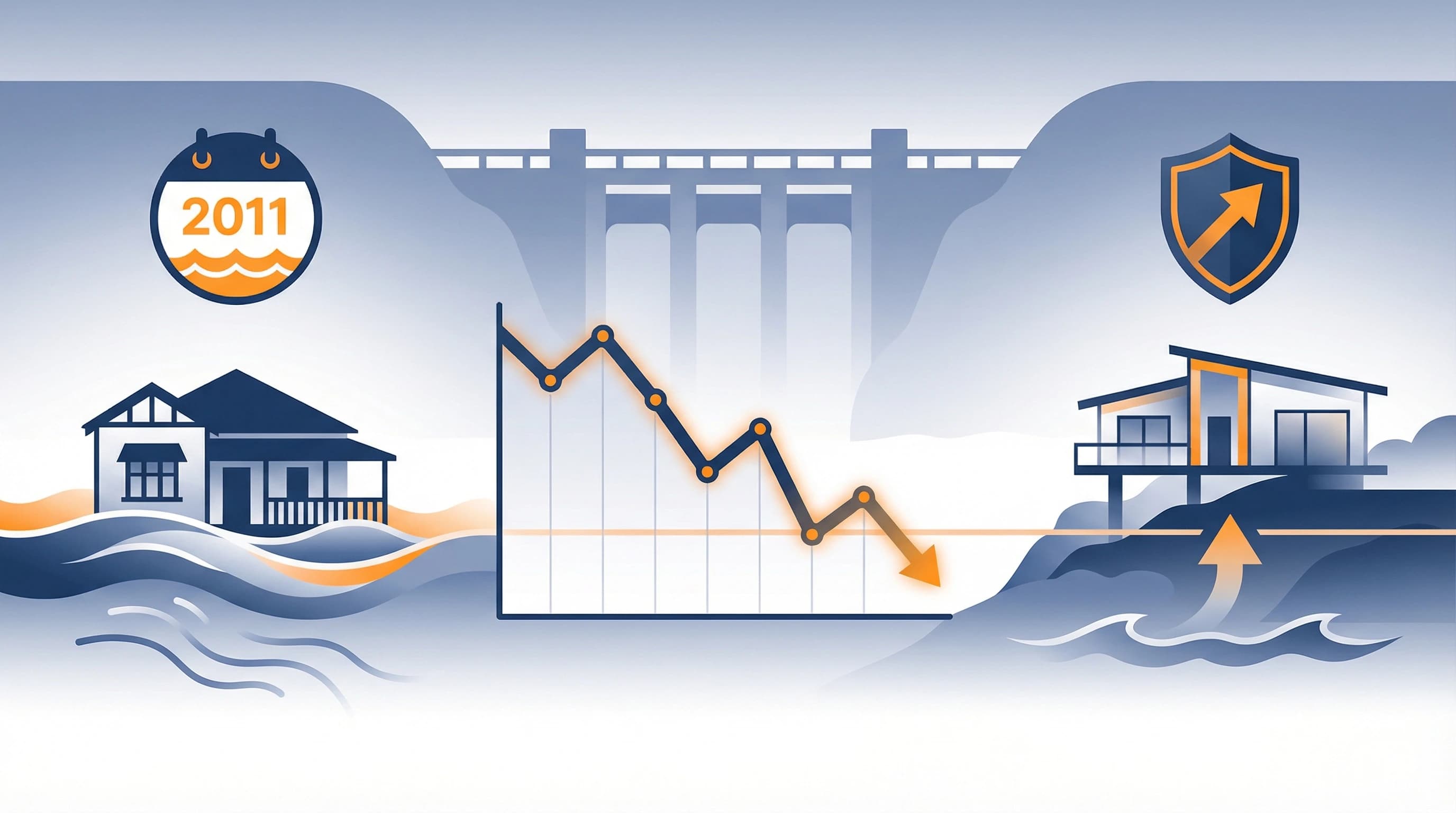
On the 11th of January 2011, a wall of water moving down the Brisbane River changed the course of countless lives and property values across South East Queensland. In the weeks that followed, approximately 28,000 properties across Brisbane were inundated or flood-affected. Total economic losses exceeded $2.38 billion in Brisbane alone, with the broader Queensland flood event generating losses of over $6.7 billion.
More than 14 years later, the 2011 Brisbane floods remain the defining reference point for understanding flood risk in this city. For property buyers in 2026, this history is not merely an interesting footnote. It is directly relevant to the properties available for sale today, the insurance premiums you will pay, and the long-term value trajectory of flood-affected assets.
This article examines what happened in 2011, how property markets responded, what the 2022 floods confirmed, and what every buyer needs to check before purchasing in an area with any flood designation.
What Happened in January 2011
The 2011 floods resulted from a sequence of extreme rainfall events across South East Queensland through December 2010 and January 2011. Wivenhoe Dam, which had been constructed specifically to provide flood mitigation for Brisbane following the devastating 1974 floods, was filled to extraordinary capacity by the sustained rainfall.
On the 11th of January, controlled releases from Wivenhoe Dam combined with direct rainfall runoff across the catchment to produce the peak flood event in Brisbane. The Brisbane River reached 4.46 metres at the City Gauge, slightly below the 1974 peak of 5.45 metres but sufficient to cause catastrophic inundation across low-lying suburbs.
The suburbs most severely affected included Rocklea, Moorooka, Yeronga, Fairfield, Chelmer, Graceville, St Lucia, Auchenflower, Rosalie, Milton, and dozens of others along the riverine flood plain and lower-lying creek catchments. Properties in these areas experienced inundation ranging from centimetres in elevated positions to several metres in the most severely affected streets.
Separately, a flash flooding event in Toowoomba and the Lockyer Valley on the 10th of January caused catastrophic loss of life and infrastructure damage on a scale that had no precedent in modern Australian experience.
How Property Markets Responded
The immediate impact on flood-affected property values was severe. Research conducted in the aftermath of the 2011 floods found that properties with documented inundation experienced price discounts of 10 to 30 percent relative to comparable unaffected properties in the same suburbs. In the most severely affected streets, discounts were even larger.
However, the market response was not uniform, and it evolved significantly over time.
In the years immediately following 2011, there was a clear flight from flood-prone areas as buyers with the capacity to choose sought higher-ground alternatives. Suburbs like Bardon, Paddington, Ashgrove, and Indooroopilly, which offered proximity to the inner city without significant flood exposure, experienced relative outperformance.
By approximately 2015 to 2017, memory fades, prices in some flood-affected suburbs had recovered substantially, and the combination of inner-city lifestyle, proximity to amenities, and larger land sizes drew buyers back. For many, the flooding of 2011 had begun to feel like history rather than an active risk.
The 2022 floods, which produced peaks close to the 2011 levels across many affected areas, corrected this complacency.
What the 2022 Floods Confirmed
In February and March 2022, South East Queensland experienced another major flood event that again inundated thousands of properties across Brisbane. The Insurance Council of Australia reported total insurance losses from the 2022 Queensland floods of approximately $4.8 billion, making it one of the costliest insured natural disasters in Australian history.
For property markets, the 2022 floods confirmed several critical realities.
Flood risk in Brisbane is not a one-off historical event. It is a recurring characteristic of the city's geography that will continue to manifest, likely with increasing frequency as climate patterns shift.
Properties that flooded in 2011 and again in 2022 demonstrated that the risk is not randomly distributed. The same low-lying locations, the same streets in the same suburbs, bear repeated exposure because the fundamental geography and hydrology driving flood behaviour has not changed.
Insurance repricing following 2022 was more severe and more permanent than the adjustments made after 2011. Many owners of flood-prone properties found that renewal premiums increased by 50 to 200 percent, or that their policies were not renewed at all.
The Insurance Reality in 2026
The flood insurance market for Brisbane properties has been reshaped by the combined impact of 2011 and 2022. Key changes that every buyer needs to understand include the following.
Standard building and contents policies may specifically exclude flood cover. Buyers of flood-designated properties need to confirm explicitly whether their policy includes flood inundation coverage and under what conditions.
Flood cover, where available, now carries substantially higher premiums for properties with any flood overlay designation. A property in a Brisbane River or creek flood planning area that might have been insured for $2,000 to $2,500 annually before 2022 may now attract premiums of $5,000 to $15,000 or higher from mainstream insurers.
Some properties, particularly those in higher-risk categories, are being declined by mainstream insurers, requiring buyers to seek coverage from specialist underwriters at significant additional cost.
The Australian Reinsurance Pool Corporation, established in 2022 to address affordability issues in cyclone-affected regions, does not directly address Brisbane River flood risk for most affected properties. Queensland government assistance programmes have targeted limited categories of the most severely affected properties.
Checking Your Property's 2011 Flood Status
For any Brisbane property with a flood overlay designation, checking whether it was physically affected in the 2011 or 2022 floods provides important context beyond the modelled overlay data.
Brisbane City Council maintains a property-level flood inundation register that records whether individual properties were inundated in the 2011 event and to what level. This information is accessible through council's property enquiry systems.
The Queensland Reconstruction Authority also published detailed mapping of affected areas following both flood events. While this data is aggregated at a street or suburb level rather than individual property level, it confirms the geographic extent of impact.
Sellers in Queensland are required to disclose known material facts about a property. Whether a property has previously flooded is arguably a material fact in most circumstances, though the precise legal obligations depend on the specific circumstances and the applicable contract conditions. Asking the seller directly, in writing, whether the property was inundated in 2011 or 2022 creates a record of the response.
What to Do Before Buying in a Flood-Designated Area
If a property you are considering carries any flood overlay designation, the following steps are essential before you exchange contracts.
First, check the PropDex report. A PropDex due diligence report, available through propdextest.com.au, shows you all three flood overlay categories that apply to the property based on current government mapping. This gives you the baseline picture of what risk the planning system has identified.
Second, obtain insurance quotes before making an offer. Contact at least three mainstream insurers and one specialist underwriter. Ask specifically about flood cover, the applicable excess, and annual premium. The premium quoted is a direct measure of how the insurance market assesses the risk.
Third, consult Brisbane City Council about the property's 2011 flood inundation history and any minimum floor level requirements that apply to the property.
Fourth, engage a solicitor who is familiar with Queensland flood disclosure obligations and has the contract reviewed with specific attention to flood-related terms.
Fifth, consider a town planner or building designer review if you have any renovation or extension plans, to confirm whether flood overlay requirements affect the feasibility of those plans.
A Historical Event That Remains a Current Risk
The 2011 Brisbane floods are history. The risk they demonstrated is not. The same topography that channelled those floodwaters through suburban streets in 2011 remains unchanged. The same river, the same creeks, the same overland drainage paths exist today.
For property buyers in Brisbane in 2026, understanding flood risk is not about avoiding an area entirely. It is about making an informed decision with a clear view of the risk profile, the insurance cost, the building requirements, and the long-term value implications. Some flood-affected suburbs offer exceptional lifestyle advantages at prices that account for the risk, and buyers who proceed with full information can make those choices confidently.
The buyers who face the worst outcomes are those who purchase without understanding the flood status of the property. That information is available, accessible, and free to check. Use it before you sign anything.
This article is for informational purposes only and does not constitute financial, legal, or insurance advice. Flood risk data and insurance market conditions are subject to change. Consult qualified professionals for advice specific to your circumstances.