Why "I'll Get a Building Inspection" Is Not Enough Due Diligence in 2026
Published 20 March 2026
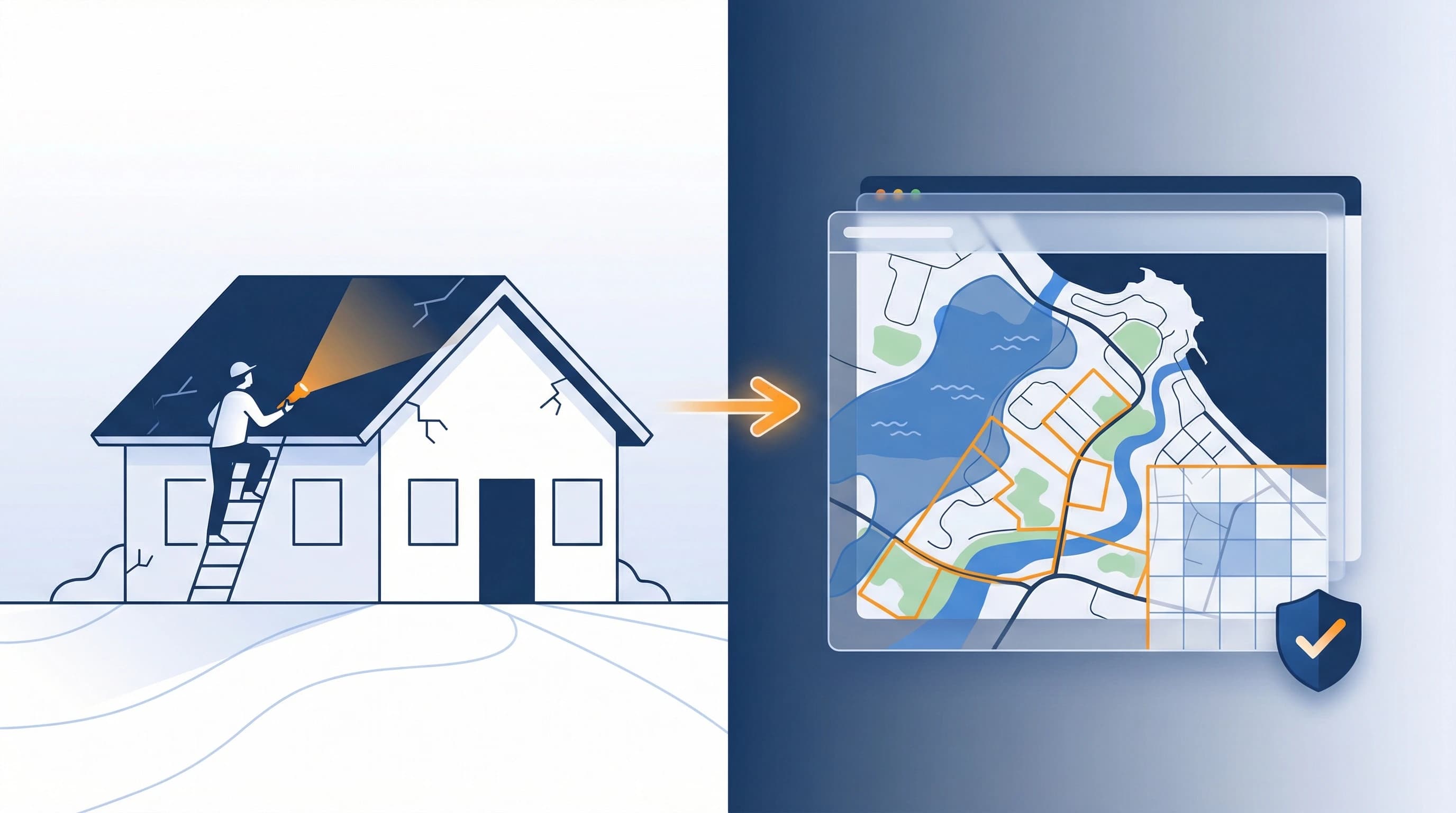
If you have ever bought property in Australia, or talked to someone who has, you have almost certainly heard the same piece of advice repeated like a mantra: "Get a building inspection done." It is standard counsel from parents, friends, mortgage brokers, and real estate agents alike.
And it is good advice, as far as it goes.
The problem is that "as far as it goes" is not very far at all. A building and pest inspection is one tool in the due diligence toolkit, and a narrow one at that. It tells you about the physical state of the structure. It tells you nothing about whether the land beneath it is in a flood zone, whether there is a drainage easement running through the backyard, whether the property falls within a heritage overlay, or whether what you plan to build is even permitted under council rules.
In 2026, with Australian property prices at record levels and climate-related risks reshaping insurance markets across the country, relying on a building inspection alone is not cautious. It is a significant financial risk.
What a Building and Pest Inspection Actually Covers
A building and pest inspection is carried out by a licensed inspector who physically examines the structure and reports on its condition. A thorough inspector will assess the roof, walls, foundations, subfloor, plumbing, electrical systems (in a general sense), and identify evidence of termite activity or structural damage caused by pests.
The report tells you whether the building is structurally sound, whether there are signs of moisture ingress, whether any visible defects exist, and whether there is evidence of pest infestation.
This is valuable information. Discovering termite damage before you buy is obviously better than discovering it after. Finding that a retaining wall is failing before you settle can give you grounds to renegotiate the price.
But the scope ends at the physical structure. An inspector does not check flood overlay maps. They do not review title documents for easements. They do not examine the planning scheme. They do not tell you what your council rates will be, whether you can extend the home, or what the flood insurance premium looks like.
The Risks That Building Inspections Do Not Capture
Brisbane is a flood city. The 2011 floods devastated thousands of homes across the greater Brisbane area, and the 2022 floods demonstrated that the risk has not diminished. Many of the suburbs most severely affected in those events were established residential areas where buyers had purchased years earlier without understanding the flood overlay status of their property.
Queensland's flood risk mapping covers three separate categories. Creek and waterway flooding occurs when local drainage systems overflow during heavy rainfall. Brisbane River flooding affects properties within the Brisbane River flood planning area. Overland flow flooding affects properties that sit in the path of stormwater runoff that exceeds the drainage system's capacity.
A property can carry risk from one, two, or all three categories simultaneously. Each category has different implications for building floor levels, development approvals, and insurance.
Beyond flood risk, easements registered on the title can fundamentally change what you are permitted to build. Zoning and planning restrictions determine development potential. Landslide risk overlays in hilly areas may require geotechnical assessments. Environmental constraints including vegetation management and koala habitat mapping can restrict clearing and development.
A building inspector working on an existing structure is not assessing any of these factors.
What Comprehensive Due Diligence Actually Looks Like
Genuine due diligence on a property purchase in 2026 covers multiple independent layers of investigation.
The physical condition of the building is one layer, captured by the building and pest inspection.
Title due diligence covers the registered easements, encumbrances, caveats, and covenants on the title. This requires a title search from the Queensland Land Registry.
Planning due diligence covers the zoning, overlays, neighbourhood plan provisions, and any development approvals or notices affecting the property. This requires reviewing the applicable planning scheme and ideally consulting a town planner for any complex scenario.
Risk due diligence covers flood, bushfire, landslide, and environmental constraints. These are primarily government spatial datasets accessible through council and state government mapping portals.
Financial due diligence covers the government land valuation, estimated council rates, water and sewerage charges, land tax implications, and insurance cost estimates.
The Time and Cost Reality
One of the reasons buyers default to a building inspection alone is convenience. Organising and reviewing information across multiple government systems takes time and requires some familiarity with planning documents that are not written for general audiences.
This is exactly the problem that a comprehensive property due diligence report solves. A PropDex report pulls together flood overlay data, easement information, government land valuations, zoning and planning details, bushfire risk status, school catchments, infrastructure mapping, and demographic data into a single document you can review before making any decisions.
It does not replace a solicitor or a town planner for complex transactions, but it gives you the foundational layer of property intelligence that should inform every purchase decision. Generate a PropDex report before you get to the point of signing anything. It takes minutes and can reveal issues that would otherwise cost you far more to discover later.
The Bottom Line
A building inspection is necessary. It is not sufficient.
In 2026, the range of risks that can affect a property purchase extends well beyond the physical condition of the structure. Flood risk is being repriced by insurers. Planning restrictions are evolving as councils update their schemes. Climate mapping is being revised as new modelling data becomes available.
Buying a property without checking these factors is not cautious. It is the opposite. The information exists, it is largely free, and checking it takes a fraction of the time it takes to recover from getting it wrong.
Do the full due diligence. Your future self will thank you.
This article is for informational purposes only and does not constitute legal, financial, or planning advice. Engage qualified professionals for your specific circumstances.