Auction Clearance Rates: What They Actually Tell You (And What They Don't)
Published 20 March 2026
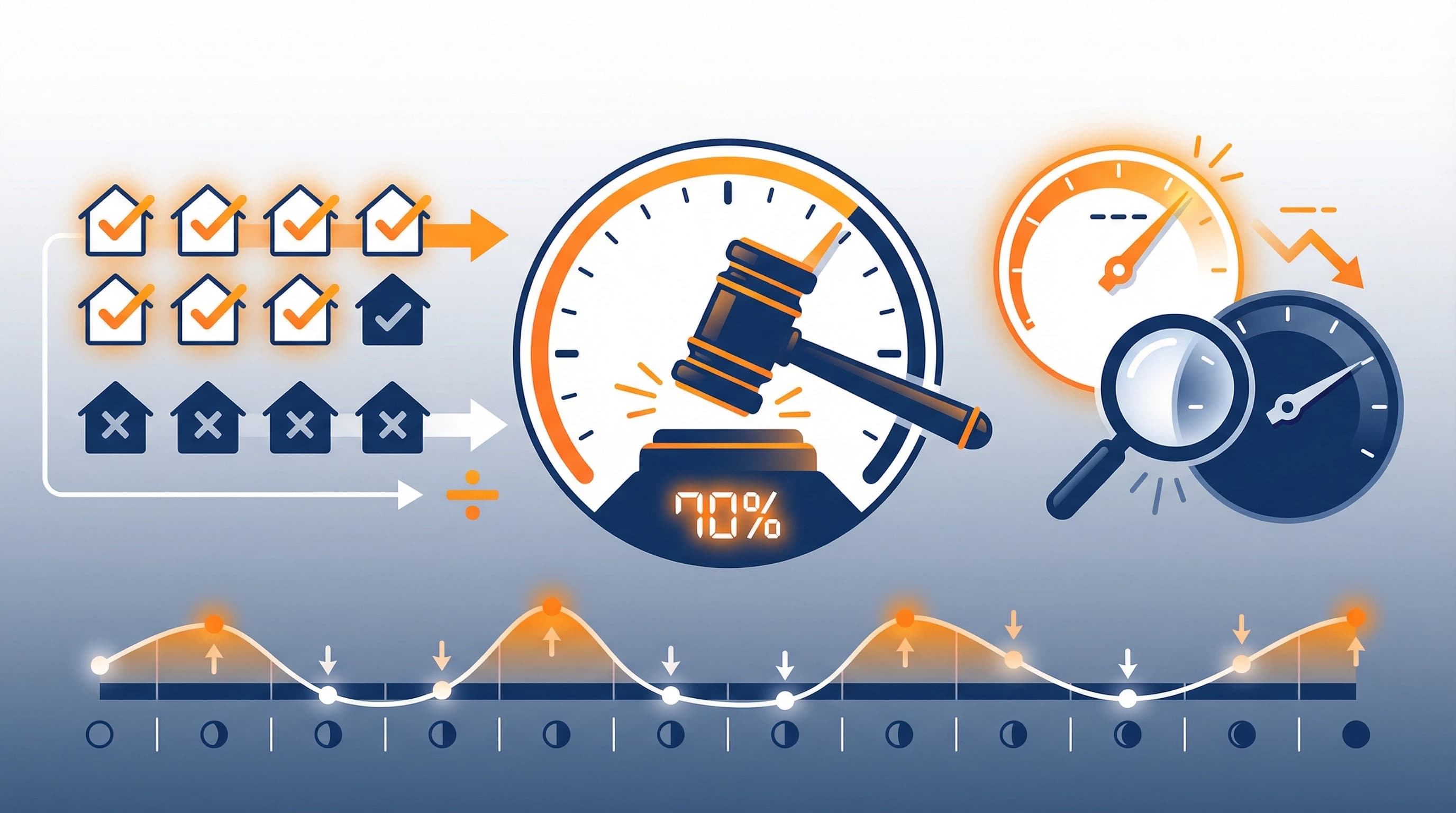
Few property market statistics attract more media attention than the weekly auction clearance rate. Every Saturday evening, property data companies and real estate industry bodies publish their figures. Monday morning commentary follows. Rising clearance rates are cited as evidence of a strengthening market. Falling rates signal softening conditions. The number takes on an almost totemic significance in property market discourse.
The clearance rate is a useful indicator. It is not, by itself, a complete picture of market conditions, and reading it without understanding its limitations leads buyers and investors to draw conclusions that the data does not support.
This article explains what the auction clearance rate actually measures, how it is calculated, where it is most and least reliable, and how to use it alongside other data to form an accurate view of market conditions.
What an Auction Clearance Rate Measures
The auction clearance rate measures the proportion of properties that were scheduled for auction in a given period and that sold, either at auction or in the days immediately following (typically prior to or on the same day as auction results reporting).
A clearance rate of 70 percent means that, of the properties scheduled for auction in that week, 70 percent sold and 30 percent did not. Properties that do not sell at auction may be passed in (bid on but not reaching reserve price), withdrawn before auction, or sold by private treaty subsequently.
At its most basic level, a clearance rate above approximately 65 to 70 percent in most Australian capital city markets indicates that buyer demand is exceeding supply at current price levels, which is a condition that supports further price growth. Clearance rates consistently below 55 percent indicate that supply is outpacing buyer demand, which typically produces price softening.
The Reporting Methodology Problem
The headline clearance rate published by property data companies on Saturday evening or Sunday morning is provisional. It is based on the results reported by selling agents at the time of publication. In most markets, agents report auction results for properties that sold. They are less consistent about promptly reporting passed-in or withdrawn results.
This systematic reporting bias produces provisional clearance rates that are meaningfully higher than the final, verified rates published later in the week when all results have been collected. In some markets and conditions, the provisional to final rate difference can be 5 to 10 percentage points.
CoreLogic is one of the more transparent publishers of this distinction, publishing both preliminary and revised final clearance rates. Comparing the preliminary rate (reported Saturday-Sunday) with the final revised rate (reported mid-week) for the same weekend gives an indication of how much the preliminary figures are overstating market strength in any given period.
A market where preliminary clearance rates are consistently 10 percentage points above the final rates is one where the reporting mix is skewed toward successes, and the true market conditions are weaker than the headlines suggest.
Volume Matters as Much as Rate
A clearance rate is only meaningful in context of the volume of properties that went to auction. A 78 percent clearance rate across 600 auctions in a week tells a very different market story to a 78 percent clearance rate across 120 auctions.
Low auction volumes occur for several reasons. Vendors may be reluctant to commit to auction in uncertain conditions, preferring to test the market through private treaty or postponing listing entirely. Holiday periods, long weekends, and school holidays suppress auction volumes. Unseasonably poor weather can affect attendance and bidder numbers.
When auction volumes are low and clearance rates are high, it often reflects the most confident vendors selecting the auction method and the most motivated buyers competing for limited stock, a combination that produces strong rates but may not represent broader market conditions.
When auction volumes are high and clearance rates are simultaneously high, that is the strongest possible signal of deep, broad buyer demand, the condition most reliably associated with price growth across the market.
Geographic Specificity: The Brisbane Context
Brisbane's auction market is structurally different to Sydney's and Melbourne's. A higher proportion of Brisbane residential sales occur through private treaty than through auction compared to the southern cities, which means the auction clearance rate as a market indicator has a smaller sample base in Brisbane than in comparable Sydney or Melbourne reports.
In Brisbane, weekend auction volumes of 200 to 500 properties were common in peak periods of 2021 and 2022. During quieter periods, weekend volumes can drop to 100 to 150. The smaller sample size makes Brisbane clearance rates more volatile from week to week and less reliable as a trend indicator than the larger Sydney and Melbourne figures.
For Brisbane property research, the clearance rate is best used alongside median days on market, vendor discount rates, and listing volumes as a composite market health indicator rather than as a standalone signal.
What Clearance Rates Do Not Tell You
Clearance rates say nothing about the price achieved relative to vendor expectations. A property sold at 5 percent below the reserve price is counted as a clearance. A property sold at 15 percent above reserve is also counted as a clearance. The rate does not capture the direction or magnitude of price movement within the cleared proportion.
Clearance rates do not distinguish between property types, price brackets, or locations within a market. A strong overall Brisbane clearance rate may reflect exceptional conditions in one suburb or price bracket with weak conditions elsewhere, averaged together.
They do not capture the private treaty market, which in Brisbane represents the majority of residential transactions. Strong auction clearance rates alongside a rising proportion of private treaty sales may indicate that vendors are adjusting their preferred sale method based on market conditions, a shift that the clearance rate alone does not reveal.
Using Clearance Rates Alongside Due Diligence Data
For a buyer using clearance rate data to gauge market conditions around a specific purchase decision, the rate is most useful as a timing indicator, signalling whether the market is in a competitive or accommodating phase.
In a high-clearance environment (above 70 percent consistently), bidding competition is real and buying decisions need to be made with confidence and preparation. Due diligence needs to be completed before auction day, not after. A PropDex due diligence report, generated at propdextest.com.au before any auction inspection, gives you the flood risk, easement status, zoning, government land valuations, and planning data you need to assess a property with confidence before the auction.
In a low-clearance environment (below 55 percent), buyers have more time and negotiating leverage. Due diligence can still be completed before offer, but the urgency pressure is lower and the scope for post-inspection negotiation is greater.
Either way, due diligence comes before commitment, not after. The auction clearance rate tells you how much competition you face in the room. It does not tell you whether the property itself is a sound purchase.
How to Read Clearance Rate Data Reliably
Use the revised final clearance rate, not the preliminary Saturday night figure. The final rate, published mid-week, is more accurate.
Pair the clearance rate with auction volume data. A high clearance rate on low volume is a weaker signal than a high rate on high volume.
Track the trend over four to eight weeks rather than reacting to a single week's result. Market conditions shift gradually, and single-week results are noisy.
Compare Brisbane-specific clearance rates to Brisbane-specific historical averages, not to Sydney or Melbourne benchmarks. The structural differences between these auction markets make cross-city comparisons unreliable.
This article is for informational purposes only and does not constitute financial or investment advice.