Bushfire Attack Level Ratings: What BAL Means for Construction and Insurance
Published 20 March 2026
For properties in or near bushfire-prone areas in Australia, the Bushfire Attack Level (BAL) rating is one of the most practically significant construction standards applicable. It determines the materials and construction methods required for any new dwelling or significant extension, and it has direct implications for construction cost and building insurance.
What Is a BAL Rating?
The Bushfire Attack Level (BAL) system is established by Australian Standard AS 3959-2018, Construction of Buildings in Bushfire-Prone Areas. It provides a framework for assessing the degree of risk from bushfire attack that applies to a specific building site and prescribes construction requirements that reduce the building's vulnerability to that risk.
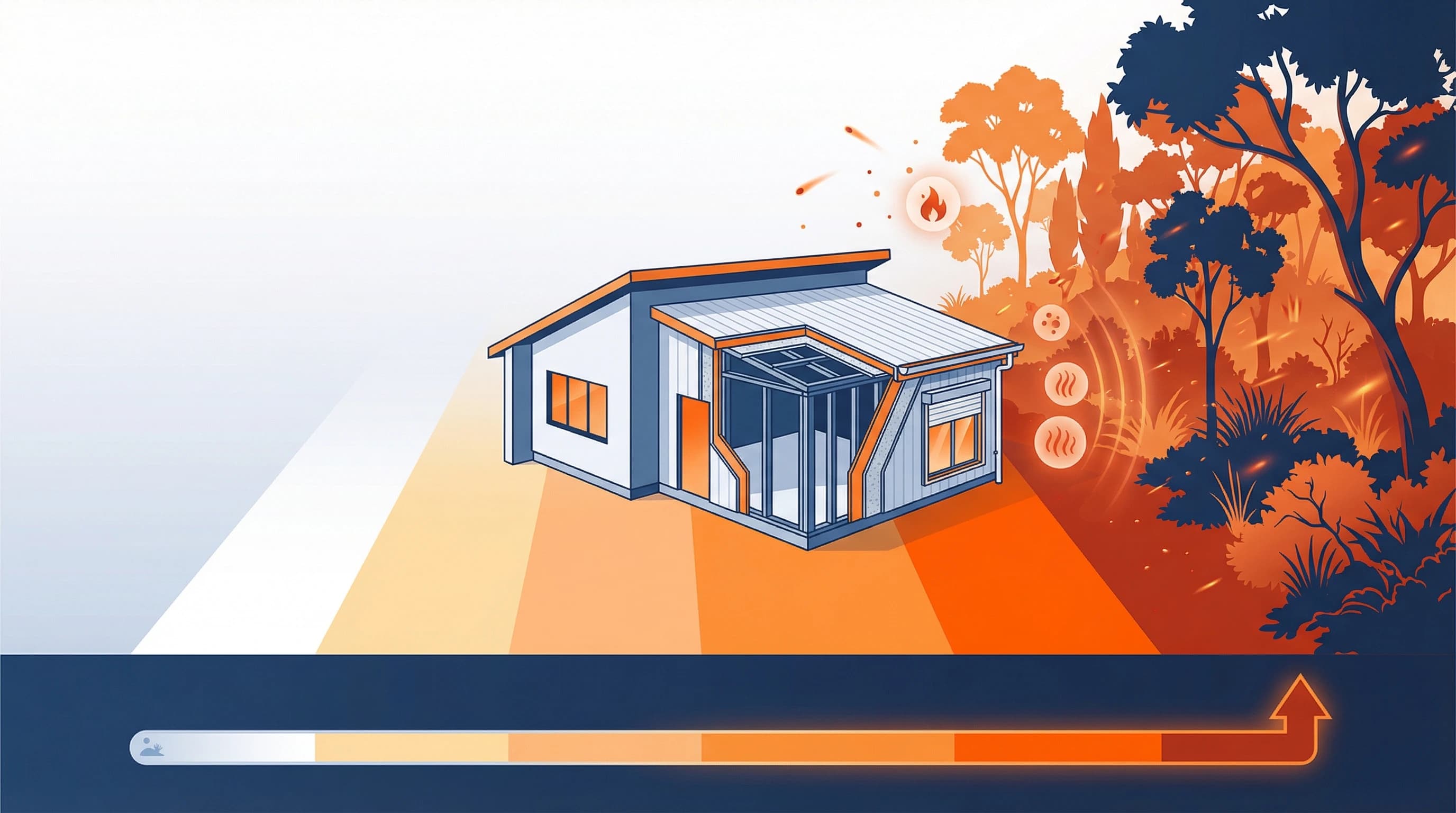
The BAL rating is determined by the combination of the site's slope, the surrounding vegetation type, and the distance between the building site and the nearest classified vegetation. The resulting rating falls into one of six categories: BAL-LOW (minimal or no specific requirements), BAL-12.5, BAL-19, BAL-29, BAL-40, and BAL-FZ (Flame Zone, the highest risk category where direct flame contact may occur).
Construction Requirements at Each Level
At BAL-LOW, no specific bushfire construction requirements apply beyond the standard Building Code of Australia (NCC) provisions.
At BAL-12.5, the building requires ember protection measures including specific requirements for gaps, vents, and openings in the building envelope.
At BAL-19, construction requirements become more substantial, including specific requirements for external walls, roofing, eaves, decks, and glazing designed to resist ember attack and radiant heat.
At BAL-29 and BAL-40, requirements escalate significantly, with steel, brick, or concrete construction increasingly specified. Timber construction becomes very limited in these categories.
At BAL-FZ, construction must withstand direct flame contact. This typically means non-combustible construction throughout, no eaves or overhangs, and extremely high-specification glazing. Construction costs at BAL-FZ are substantially higher than at lower ratings, and some lenders require specific assessment before providing finance for BAL-FZ properties.
The additional construction cost of meeting BAL requirements above BAL-LOW can range from $8,000 to $15,000 for BAL-12.5, to $30,000 to $60,000 for BAL-29 and BAL-40, to $80,000 and above for BAL-FZ, depending on the design and construction approach.
Checking Bushfire Risk Before Buying
Brisbane City Council's CityPlan 2014 bushfire overlay identifies properties within Bushfire Prone Areas. A PropDex due diligence report includes the bushfire risk status for any Queensland property, with a clear/found indicator and the applicable risk category.
For properties showing any bushfire overlay designation, confirming the specific BAL rating applicable to the building site is the next step. This requires a formal BAL assessment by a qualified assessor, using the AS 3959-2018 methodology. The cost of a BAL assessment is typically $400 to $1,200 depending on the site complexity.
Before purchasing any property in a bushfire-prone area with plans for construction or significant renovation, obtaining a BAL assessment as part of your pre-purchase due diligence gives you the specific construction cost implications you need to make an informed decision.
Visit propdextest.com.au to check the bushfire overlay status of any Queensland property as a first-line indicator.
This article is for informational purposes only and does not constitute legal, financial, or planning advice.