The Complete Due Diligence Checklist: 25 Checks Before You Exchange
Published 20 March 2026
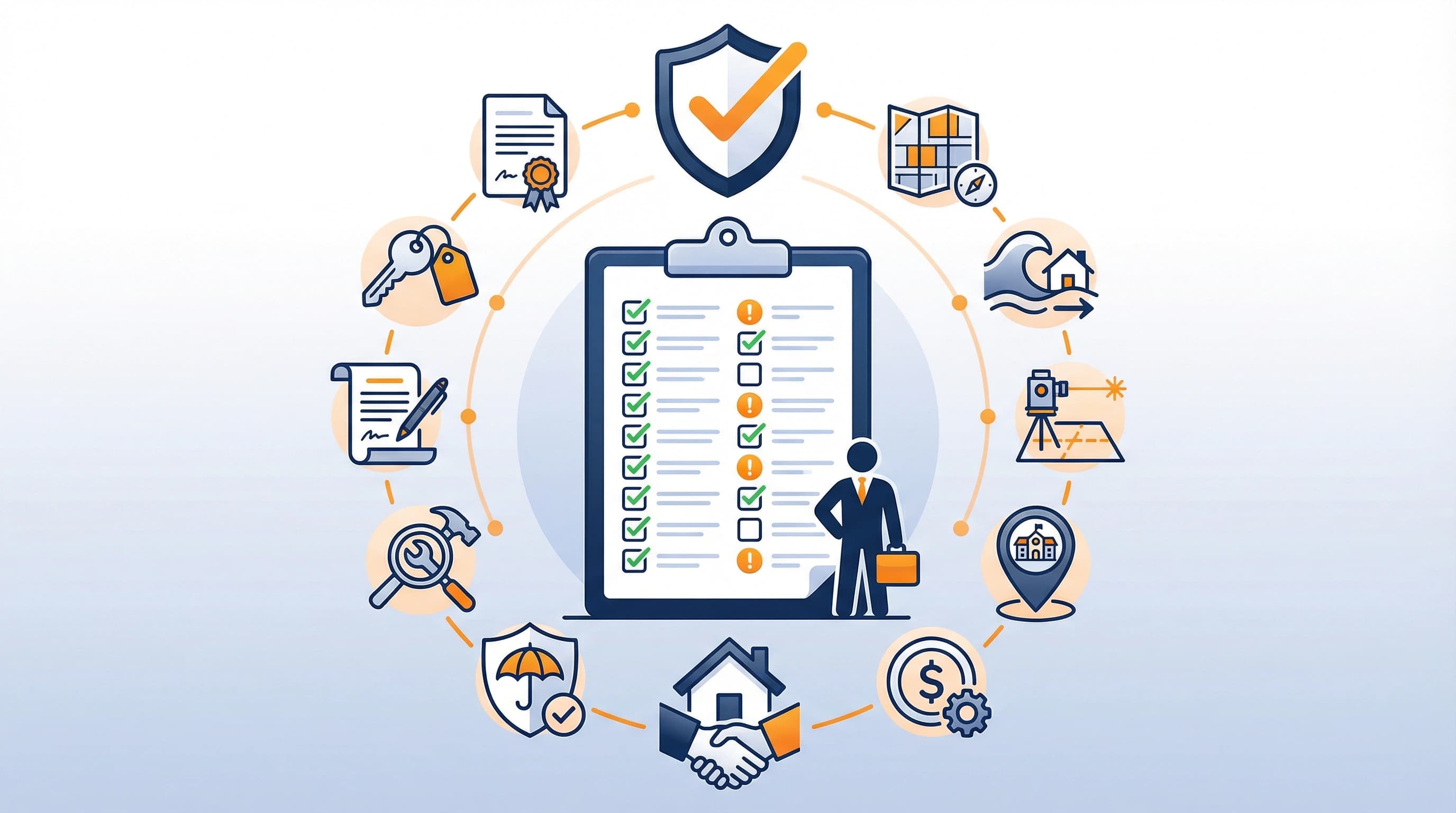
Exchanging contracts on a property is one of the most significant financial commitments most people will make in their lives. Yet it remains common for buyers to enter that commitment without having systematically verified the information that determines whether the property is what they believe it to be, at a price that reflects its actual characteristics.
This checklist covers 25 specific checks that every buyer should complete before exchanging contracts on any Queensland residential property. Some can be done in minutes online. Others require professional assistance. All of them are worth completing before you are legally committed.
Section 1: Title and Legal Checks
Check 1: Obtain a Title Search
A current title search from the Queensland Land Registry confirms the registered owner, any registered interests (mortgages, easements, covenants, caveats), and the lot and plan number of the property. Your conveyancer will conduct this search as part of their standard process, but you should ask for a copy and review it yourself before exchange, not after.
Check 2: Verify the Lot and Plan Number
Confirm that the lot and plan number on the title corresponds to the property you inspected. This sounds basic but errors occur, particularly with units and townhouses in complex community title schemes.
Check 3: Confirm Tenure Type
Is the property freehold or leasehold? Most Brisbane residential properties are freehold, but some properties in tourist precincts, on Crown land, or in older estates carry leasehold tenure. Leasehold properties have different financing, resale, and rights implications than freehold.
Check 4: Review the Contract of Sale Carefully
Review the full contract, not just the price and settlement date. Confirm the inclusions and exclusions, any special conditions, the deposit amount and when it becomes unconditional, the settlement period, and any representations made by the agent or vendor that you are relying on. Have your solicitor review the contract before you sign.
Check 5: Check for Caveats or Other Registered Interests
Beyond standard mortgages, look for any unusual registered interests. A caveat from a third party claiming an interest in the property, or an unresolved covenant affecting use, are matters your solicitor needs to advise you on before exchange.
Section 2: Planning and Zoning Checks
Check 6: Confirm the Zoning
Using BCC CityPlan 2014 (or the applicable planning scheme for the local government area), confirm the base zone applicable to the property. The zone determines what you can do with the land, including whether a granny flat, second dwelling, or subdivision is permissible.
Check 7: Check All Planning Overlays
Review the overlays applicable to the property, including flood overlays (all three categories), bushfire, landslide, heritage, character, transport noise corridor, koala habitat, and vegetation management. Each overlay has specific implications. A PropDex report at propdextest.com.au covers all of these in a single check.
Check 8: Review Any Neighbourhood Plan Provisions
If the property is in a neighbourhood plan area, identify the precinct and the applicable planning codes. Pay particular attention to character provisions if you intend to renovate or extend a pre-1947 dwelling, and to density and height provisions if you have any development intentions.
Check 9: Confirm Minimum Lot Size Requirements
If subdivision or dual occupancy is part of your plan, confirm the minimum lot size and frontage requirements applicable to the zone and verify that the property meets them. A marginal lot that appears to qualify may fail on one dimensional requirement.
Section 3: Flood and Environmental Risk Checks
Check 10: Identify the Flood Overlay Category
Determine whether the property is affected by creek or waterway flooding, Brisbane River flooding, or overland flow risk. If any category is identified, understand the implications for building construction, insurance, and resale.
Check 11: Obtain Flood Level Data
For properties in a flood overlay, request the applicable flood level (in metres AHD) from Brisbane City Council. This is the data point that drives minimum floor level requirements for any construction or extension.
Check 12: Get Insurance Quotes Before Commitment
Contact at least three insurers and request quotes specific to the property address, including full flood inundation cover. Do this before you make an offer or, at minimum, before your finance condition lapses.
Check 13: Check Bushfire Risk
Confirm whether the property is within a Bushfire Prone Area under the applicable planning scheme. If it is, obtain a BAL assessment to understand the construction requirements applicable to any building work.
Check 14: Review Environmental Designations
Particularly for properties in outer suburbs or on larger lots, check vegetation management categories and koala habitat designations. Both can restrict clearing and development.
Section 4: Physical and Building Checks
Check 15: Commission a Building and Pest Inspection
A licensed building inspector should complete a visual inspection of all accessible areas of the dwelling for structural issues, drainage problems, roof condition, and timber pest activity. Request that the inspection specifically addresses any flood or moisture-related issues given the property's flood status.
Check 16: Inspect the Property at Different Times
Inspect during daylight and, if possible, after significant rain to observe drainage performance around the property. An inspection during dry conditions tells you only part of the picture.
Check 17: Confirm Sewer and Water Connection
For established properties, confirm that the dwelling is connected to reticulated sewerage and water supply. For rural residential properties, confirm the nature of the water supply (council, dam, tank, bore) and waste disposal (septic, sewerage).
Check 18: Check for Any Council Orders or Notices
A local government rates and charges search will disclose any outstanding orders or notices on the property issued by council, such as improvement notices, compliance notices, or notices relating to unapproved structures.
Check 19: Verify That Structures Are Council-Approved
Ask the agent or vendor for confirmation that all structures on the property, including extensions, decks, sheds, pools, and pergolas, have been constructed with council approval. Unapproved structures can create liability for the buyer and may need to be removed or approved at cost.
Section 5: Financial and Market Checks
Check 20: Review the Government Land Valuation
The Queensland Government's annual land valuation for the property provides an independent, government-issued assessment of the land component value. Compare this to the purchase price to understand how the asking price sits relative to the assessed land value.
Check 21: Research Comparable Sales
Review genuine comparable sales data from the past 6 to 12 months for similar properties in the same suburb. Recent sales are the most reliable indicator of market value. Your conveyancer or a buyer's advocate can assist with this analysis.
Check 22: Confirm Council Rates
Request a copy of the most recent council rates notice to understand the annual council rates liability. Compare this to properties in other suburbs you are considering if cost is a significant factor.
Check 23: Estimate Holding Costs in Full
Before committing, prepare a full holding cost estimate including council rates, water rates, insurance, body corporate levies (if applicable), maintenance, and land tax (for investment properties). The total cost of ownership often differs substantially from the mortgage repayment alone.
Section 6: Neighbourhood and Amenity Checks
Check 24: Confirm School Catchment Boundaries
If school access is a factor in your purchase decision, confirm the catchment boundaries for both primary and secondary state schools using the Queensland Department of Education's School Catchment Finder. A PropDex report also shows school catchment mapping for any Queensland property.
Check 25: Research Planned Infrastructure and Development Nearby
Check council's development application portal for any recently approved or pending development applications in the immediate vicinity of the property. A new medium-density development adjacent to the property you are buying may not affect your decision, but it is information you should have before you commit.
The PropDex Starting Point
A significant number of the checks above draw on data that a PropDex due diligence report consolidates in a single document: flood overlay status, all planning overlays, government land valuation, easements, school catchments, public transport, amenity proximity, and suburb market data.
Running a PropDex report at propdextest.com.au before making an offer, or at minimum before your due diligence period expires, gives you the data foundation for the majority of these 25 checks. It does not replace legal advice, building inspections, or insurance research, but it eliminates the most common information gaps that lead to post-settlement regret.
Do your homework before you exchange. The property will still be there after you have completed your due diligence. The financial consequences of skipping these checks can last a great deal longer than the time it takes to complete them.
This article is for informational purposes only and does not constitute legal, financial, or planning advice. Engage qualified professionals for advice specific to your circumstances and purchase.