The Real Cost of Building in a Flood Planning Area in Queensland
Published 20 March 2026
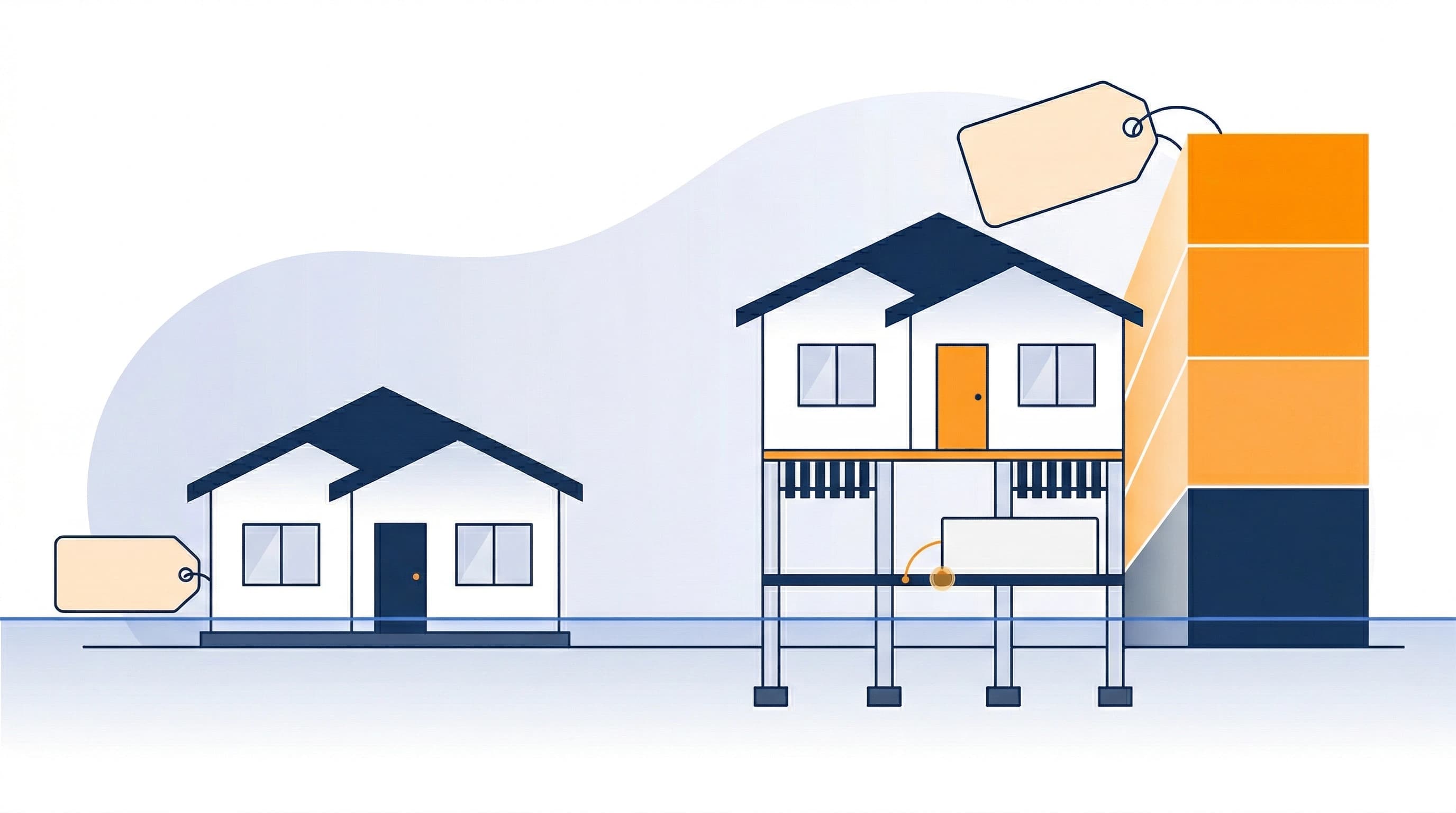
Purchasing a property within a flood planning area in Queensland and then building on it costs more than the same construction on an equivalent non-flood-affected site. Sometimes the difference is modest. Sometimes it is enough to change the entire economics of a project.
Understanding the specific cost drivers of flood-compliant construction before you commit to a site is essential for any builder, developer, or owner-builder working in Queensland.
Elevated Floor Levels: The Foundation of Flood Compliance
The most fundamental requirement for buildings within a flood planning area in Queensland is compliance with minimum habitable floor levels. These levels are set by the applicable flood planning area provisions under BCC CityPlan 2014 and are calculated based on the modelled flood level for the site plus a freeboard allowance (typically 0.3 to 0.5 metres above the modelled flood level).
For a site where the modelled flood level is, say, 8.2 metres AHD (Australian Height Datum) and a freeboard of 0.5 metres applies, the minimum habitable floor level is 8.7 metres AHD. If natural ground level at the building footprint is 7.9 metres AHD, the floor must be raised approximately 0.8 metres above natural ground.
The two primary structural approaches to achieving an elevated floor are a suspended floor on piers or stumps, or a reinforced concrete slab raised to the required level on compacted fill. Both approaches add cost. A suspended timber floor on stumps for a standard three-bedroom house in Brisbane adds approximately $25,000 to $50,000 to the construction cost relative to a conventional slab-on-ground. A filled and elevated slab can range from $15,000 to $45,000 depending on the volume of fill required and the site's accessibility for earthmoving equipment.
Flood-Resilient Materials: The Hidden Compliance Cost
Brisbane City Council's flood provisions require flood-resilient materials in areas likely to be inundated. This requirement applies to walls, flooring, and fixtures in the flood-affected zone (typically below the required habitable floor level).
Flood-resilient materials are those that can withstand inundation and drying out without permanent structural damage. This rules out standard plasterboard walls, engineered timber flooring, standard particle board cabinetry, and carpet. Compliant alternatives include fibre cement sheeting, ceramic tiling, solid timber flooring, and moisture-resistant cabinetry.
The material cost differential varies by specification and project, but a rough estimate for a typical flood-compliant lower level (used for car parking and storage) is an additional $8,000 to $20,000 in material and labour costs relative to conventional finishes.
Insurance: A Permanent Ongoing Cost Imposition
As discussed in earlier articles, building insurance for flood-affected properties is substantially more expensive than for equivalent non-flood properties. This is not a construction cost but it is a cost that lasts for the life of the building.
For a new dwelling constructed in a flood planning area in Brisbane, the building insurance premium may be $5,000 to $12,000 per year, compared to $1,800 to $2,500 for an equivalent new dwelling outside the flood overlay. Over a 30-year mortgage term, the cumulative insurance premium difference is $93,000 to $285,000 in additional insurance cost.
This ongoing cost should be explicitly factored into any financial feasibility analysis for a flood-affected development site.
Development Approval Conditions: Time and Professional Fees
Development applications for projects in flood planning areas in Brisbane typically attract conditions that add both professional fee costs and project timeline extensions.
A hydraulic or flooding report prepared by a qualified civil engineer may be required to demonstrate that the proposed development complies with the applicable flood provisions. This report typically costs $3,000 to $12,000 depending on the site complexity and the assessment requirements.
If the project requires a stormwater management plan (which is common for any development increasing impervious surface area), additional engineering and application costs apply.
Approval timelines for flood-affected sites are often longer than for unconstrained sites, as council's assessment requires additional technical review. Extended timelines increase holding costs and financing costs.
The Financial Feasibility Assessment
For any development project on a flood-affected site, a financial feasibility assessment should incorporate all of the cost items above. A project that appears viable based on comparable sales evidence may become unviable when the additional construction costs, professional fees, extended timeline, and ongoing insurance cost premium are properly accounted for.
PropDex reports include flood overlay data for any Queensland property, giving developers the initial input needed to identify flood-affected sites before beginning a detailed feasibility analysis. Run a PropDex report at propdextest.com.au as the first step in any site assessment.
This article is for informational purposes only and does not constitute legal, financial, or planning advice.