Before You Buy That Development Site: The 14-Point Planning Check
Published 20 March 2026
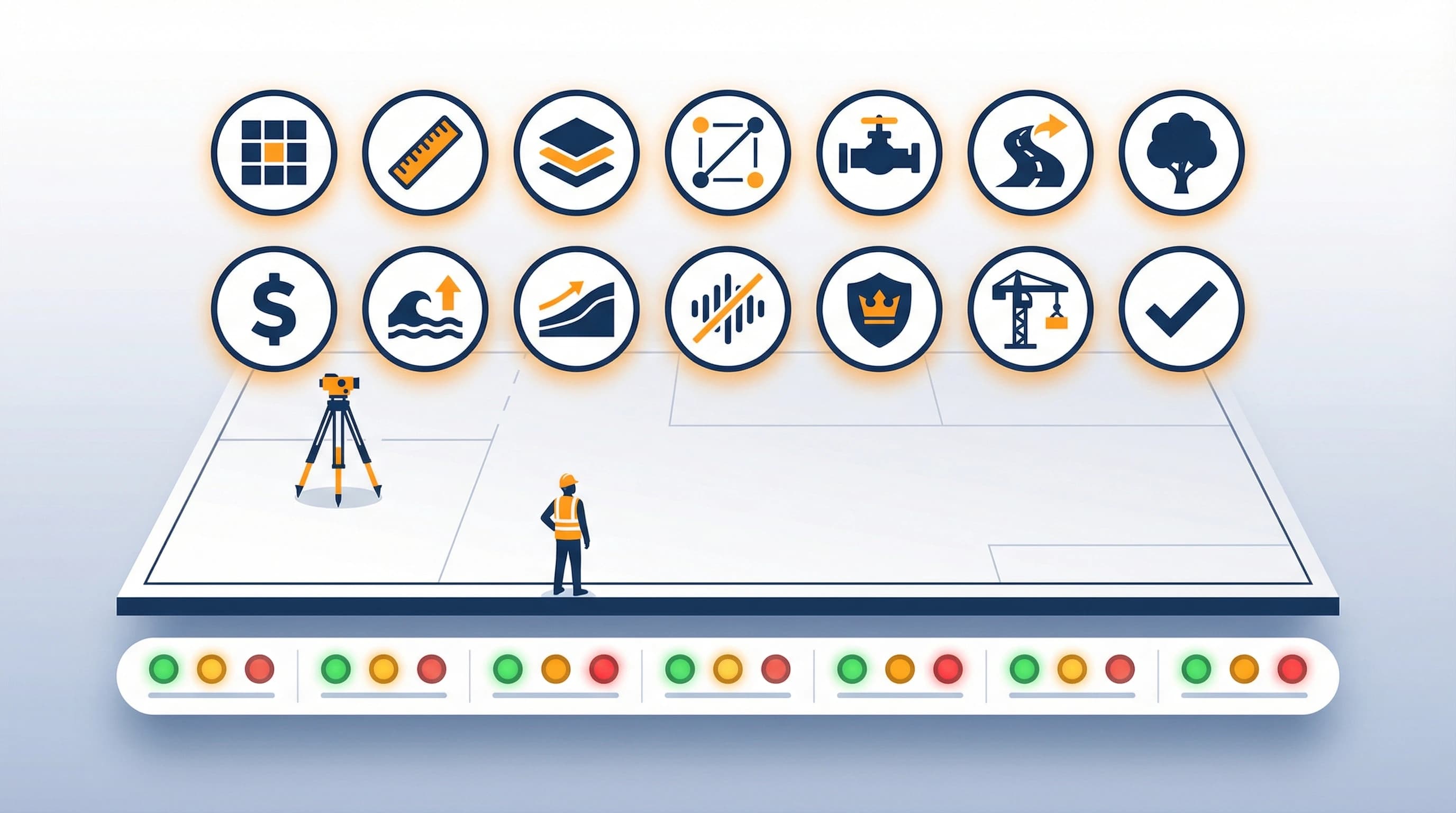
Development site due diligence is categorically different from residential property due diligence. A family buying a home needs to understand flood risk, easements, and school catchments. A developer purchasing a site for subdivision or construction needs all of that, and more, before any capital is committed.
Getting development site due diligence wrong is expensive in a way that individual residential purchases rarely are. The cost of discovering after purchase that a site cannot be developed as intended, or that development comes with conditions that eliminate the project's financial viability, can run to hundreds of thousands of dollars in sunk costs, opportunity cost, and holding costs on an asset that cannot be monetised.
This 14-point checklist is not exhaustive for every project type, but it covers the core planning and title checks that every developer should complete before exchanging contracts on any site.
Check 1: Base Zone and Permitted Uses
The zone code under the applicable planning scheme determines what uses and development types are permitted as-of-right, assessable with code assessment, assessable with impact assessment, or prohibited.
In Brisbane under BCC CityPlan 2014, a Low Density Residential (LDR) zone permits single dwellings as-of-right. Dual occupancies may be permissible with code assessment depending on lot size. Multiple dwellings and other higher-density uses require impact assessment or may not be permitted at all.
Before purchasing a site for a specific development outcome, confirm that the proposed use is permitted under the base zone, at what assessment level, and under what code provisions.
Check 2: Minimum Lot Size and Subdivision Potential
Every planning zone carries minimum lot size requirements that determine whether a parcel of land can be subdivided to create additional lots. In Brisbane's LDR zone, the minimum lot size for standard format lots is generally 400 square metres, though minimum frontage requirements and other controls also apply.
Confirm the minimum lot size and frontage requirements before purchasing any site where subdivision is part of the development strategy. A lot that appears suitable for subdivision may fail one of the dimensional requirements when properly assessed.
Check 3: Applicable Overlays
Planning overlays can add requirements or restrictions that significantly affect development outcomes. Key overlays to check for any development site include flood overlays (all three categories), the bushfire overlay, the landslide overlay, heritage overlays, character overlays, the transport noise corridor overlay, vegetation management overlays, and environmental values overlays.
Each of these can either add conditions to a development approval (minimum floor levels, acoustic treatment, geotechnical assessment requirements) or, in extreme cases, prevent development entirely.
A PropDex due diligence report covers all of these overlay categories for any Queensland property and presents them in a format that immediately flags any identified issues. Running a PropDex report at propdextest.com.au is the most efficient first-line overlay check available.
Check 4: Neighbourhood Plan Provisions
Where a neighbourhood plan applies, review the specific precinct code that applies to the development site. Neighbourhood plans can modify base zone provisions significantly, imposing character requirements, height limits, density controls, or precinct-specific design requirements.
Check 5: Infrastructure Charges Estimate
Infrastructure charges are payable for most new development in Queensland under the Planning Act 2016. The charges are calculated on a per-unit or per-lot basis using the applicable infrastructure charges schedule for the council area.
For Brisbane City Council, the charges schedule is publicly available on council's website. Charges vary by development type, location, and the applicable infrastructure charges notice. For a standard dual occupancy in Brisbane, infrastructure charges might range from $30,000 to $60,000 per additional dwelling unit created.
Obtain an estimate of infrastructure charges before committing to any site where their payment is a project cost.
Check 6: Easements and Overlay Mapping
Review title for easements as described in Article 18. For development sites, also obtain a utility infrastructure search covering the positions of sewer mains, stormwater mains, and water mains across the site. These infrastructure lines create de facto building exclusion zones even where no formal easement is registered.
Check 7: Contamination History
Sites with a history of commercial, industrial, or agricultural use may carry soil contamination that requires remediation before residential development. The Queensland Environmental Protection Act creates liability for contamination, and transferring ownership does not transfer that liability away from a developer who knew or should have known about the contamination.
Check the Queensland Environmental Management Register and Contaminated Land Register for any entries affecting the site before purchasing.
Check 8: Heritage Listing
A heritage listing at either local or state level can significantly restrict what development is permissible on a site. Confirm heritage status through the BCC Heritage Register and the Queensland Heritage Register before committing.
Check 9: Vegetation and Koala Habitat Mapping
If the site contains vegetation, confirm whether it is classified under Queensland's Vegetation Management Act and whether any koala habitat mapping applies. Both can trigger assessment requirements that affect the development timeline and cost.
Check 10: Stormwater and Drainage Requirements
Review the stormwater infrastructure mapping for the site and its relationship to the surrounding drainage network. Development that significantly increases impervious surface area typically requires on-site detention to manage peak stormwater flows. The engineering cost and land area required for detention can affect the development yield.
Check 11: Sewer Connection Feasibility
Confirm the sewer main locations relative to the site and the feasibility of connecting the proposed development. Sites where gravity connection to an existing main is not achievable may require pressure mains or pump infrastructure at the developer's cost.
Check 12: Water Connection Point
Confirm the availability of a suitable water connection point and the pressure available to service the proposed development. Multi-lot developments may require pressure main extensions or booster systems.
Check 13: Access and Frontage
Confirm the access arrangements for the site. Sites with limited or indirect road access may face access requirements as part of development approval. Corner sites and sites with dual frontages may have specific access point requirements under council's transport design standards.
Check 14: Pre-Lodgement Meeting with Council
Before committing to a development site and before lodging any application, a pre-lodgement meeting with Brisbane City Council can clarify how council's officers are likely to assess the proposed development. Pre-lodgement advice is not binding, but it provides valuable intelligence on likely assessment issues and can inform the design strategy before application.
A PropDex due diligence report covers checks 1 through 3 comprehensively, and provides supporting information for checks 4, 6, 7, 8, 9, 10, and 11. It is the starting point for any development site assessment before deeper specialist investigations begin.
This article is for informational purposes only and does not constitute legal, financial, or planning advice.