Government Land Valuations vs. Market Value: The Difference That Could Cost You Thousands
Published 20 March 2026
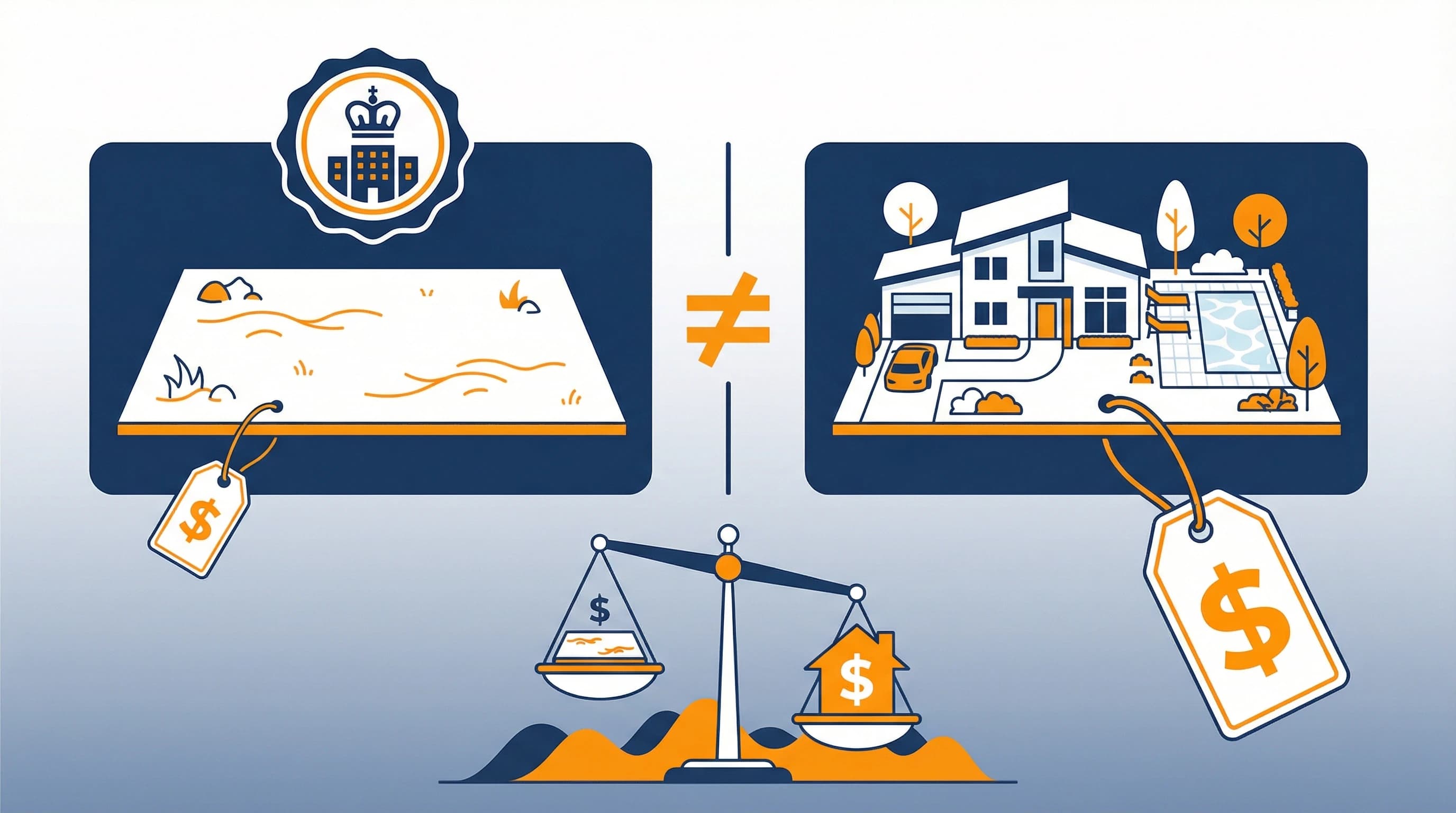
If you have spent any time looking at Queensland property data, you have probably encountered the government land valuation figure. It appears on council rate notices, in the property data sections of real estate listings, and in due diligence reports. It looks like a property value. It sounds like a property value. And it causes consistent confusion for buyers, investors, and even some property professionals.
The government land valuation is not the market value of a property. Understanding the difference between these two figures, what they each measure, and how each affects you as a buyer or property owner, is essential knowledge for anyone navigating the Australian property market.
What Is the Government Land Valuation?
In Queensland, the Valuer-General conducts annual statutory valuations of all land parcels across the state. These valuations are established under the Land Valuation Act 2010 and are used for a limited set of statutory purposes.
The critical distinction is in the name. The government land valuation assesses the unimproved value of the land. This means the value of the bare land as if no buildings, improvements, or structures existed on it. The house, the pool, the landscaping, the fencing, the shed, the concrete driveway, all of this is excluded from the government land valuation.
The Valuer-General conducts these assessments using a mass appraisal methodology that analyses sales evidence from comparable land parcels across the relevant area. The assessments are conducted annually for most Queensland properties and are applied as at the first of October each year.
A current government land valuation for a property in Middle Park, Brisbane might be $640,000. If the total market value of the property (land plus house and all improvements) is $1.4 million, the land valuation represents roughly 46 percent of the total market value. In other cases, particularly for older houses on large blocks in inner suburbs, the unimproved land value might represent 60 to 80 percent of the total market value.
What Are Government Land Valuations Used For?
Government land valuations in Queensland have two primary statutory uses.
The first is as the basis for calculating Brisbane City Council rates. Brisbane City Council applies a rate in the dollar to the unimproved land value to calculate the general rate component of your annual rates notice. The current rate in the dollar for residential properties in Brisbane is 0.00437. A property with a government land valuation of $640,000 generates a general rate of approximately $2,797 per year before any additional levies or charges.
The second is as the basis for calculating Queensland land tax. Land tax is an annual tax levied by the Queensland Government on land holdings above the $600,000 threshold (as at the 2024-25 financial year). It applies to investors and companies, but not to owner-occupied principal places of residence. The land tax calculation uses the total of all Queensland land holdings on an aggregated basis.
Government land valuations are not used to calculate stamp duty (which is based on the purchase price or market value, whichever is greater), mortgage assessments (which use the bank's own valuation), or any other standard property transaction tax.
What Is the Market Value of a Property?
The market value of a property is the price that would be agreed between a willing buyer and a willing seller in an arm's length transaction in the open market, with both parties acting knowledgeably and without compulsion.
In a practical context, market value is what a property sells for at auction or private treaty. It reflects the land value, the value of all improvements (particularly the house), the property's condition and presentation, the location's amenity and accessibility, comparable recent sales, the current state of the market, and buyer sentiment.
Market value is assessed by professional valuers (typically certified practising valuers who are members of the Australian Property Institute) using a combination of direct comparison, capitalisation, and sometimes income approaches. Banks and lenders commission these valuations to confirm that the security they are lending against is worth what a buyer has agreed to pay.
Real estate agents estimate market value through a Comparative Market Analysis (CMA), which is an informal assessment based on recent comparable sales. Automated valuation models (AVMs) used by property data companies like CoreLogic and Domain apply statistical modelling to estimate market value from large datasets of recent sales and property characteristics.
Why the Confusion Matters
The practical consequence of confusing government land valuation with market value is that buyers and sellers sometimes make errors in their price expectations.
A buyer who sees a government land valuation of $800,000 and assumes the property should sell for something near that figure may be either disappointed (if the house adds significant value) or incorrect (if the house is in poor condition and the land value is actually lower than the government assessment).
An investor comparing a government land valuation to recent sale prices in the same area can use the relationship between the two as a rough indicator of land price efficiency. In areas where government land valuations are close to or above recent total sale prices, the land component of the market is potentially being valued more efficiently, and there may be less speculation embedded in prices.
For rate-calculation purposes, a rising government land valuation is a leading indicator of higher future council rates. When the Valuer-General releases new valuations, properties whose land values have increased significantly will see corresponding rate increases at the next council billing cycle.
How to Use Government Land Valuations as a Buyer Tool
Rather than being confused by government land valuations, buyers can use them constructively in several ways.
Benchmarking land component. By comparing the government land valuation against the purchase price, you can estimate what portion of your purchase price represents land value versus improvements. This ratio is relevant for long-term investment thinking, since land typically appreciates faster than depreciating building structures.
Comparing surrounding valuations. A property's government land valuation relative to comparable nearby lots can reveal whether the specific lot commands a premium or discount for characteristics like size, aspect, or corner position. A PropDex due diligence report includes surrounding property valuations from the Valuer-General database, enabling this kind of comparison without additional research.
Estimating holding costs. The government land valuation is the direct input into the council rates calculation. Knowing the land valuation before you buy allows you to estimate your annual council rates commitment with reasonable accuracy.
Land tax planning for investors. For investors building a portfolio, tracking the aggregate Queensland land value across holdings against the land tax threshold ($600,000 in 2024-25) is important for cash flow planning. Government land valuations provide the inputs for this calculation.
Objecting to a Government Land Valuation
If you believe the government land valuation for your property is incorrect, Queensland law provides a formal objection process. You have 60 days from the date of the valuation notice to lodge an objection with the Valuer-General.
Successful objections require evidence that the assessed unimproved land value is either too high or too low relative to comparable sales evidence. Property valuers with experience in objection processes can provide professional support if the amount involved justifies the cost.
The PropDex Report and Government Land Valuations
A PropDex property due diligence report includes the current government land valuation for the property you are researching, along with the land valuations for comparable properties in the immediate surrounding area. This gives you a property-specific snapshot of land values based on the Valuer-General's official assessment.
This information, combined with the broader market snapshot data and ownership cost estimates in the report, gives you a more complete picture of the financial context around any property purchase. Visit propdextest.com.au before you make any offer to access this data for the specific property you are considering.
Summary: The Key Differences at a Glance
The government land valuation measures only the unimproved land value, assessed by the Valuer-General for rating and taxation purposes. It is updated annually and applied as at 1 October each year.
The market value measures the total value of the property (land plus improvements) as agreed between buyers and sellers in the open market. It reflects current market conditions, property condition, and comparable sales.
Using government land valuations in place of market values in any pricing or investment analysis will produce incorrect conclusions. Understanding the distinction keeps your property analysis grounded in the right data for the right purpose.
This article is for informational purposes only and does not constitute financial, legal, or taxation advice. Queensland land tax thresholds and council rate structures are subject to annual change. Always verify current rates with the relevant authority.