How to Use Government Land Valuations to Find Undervalued Properties
Published 20 March 2026
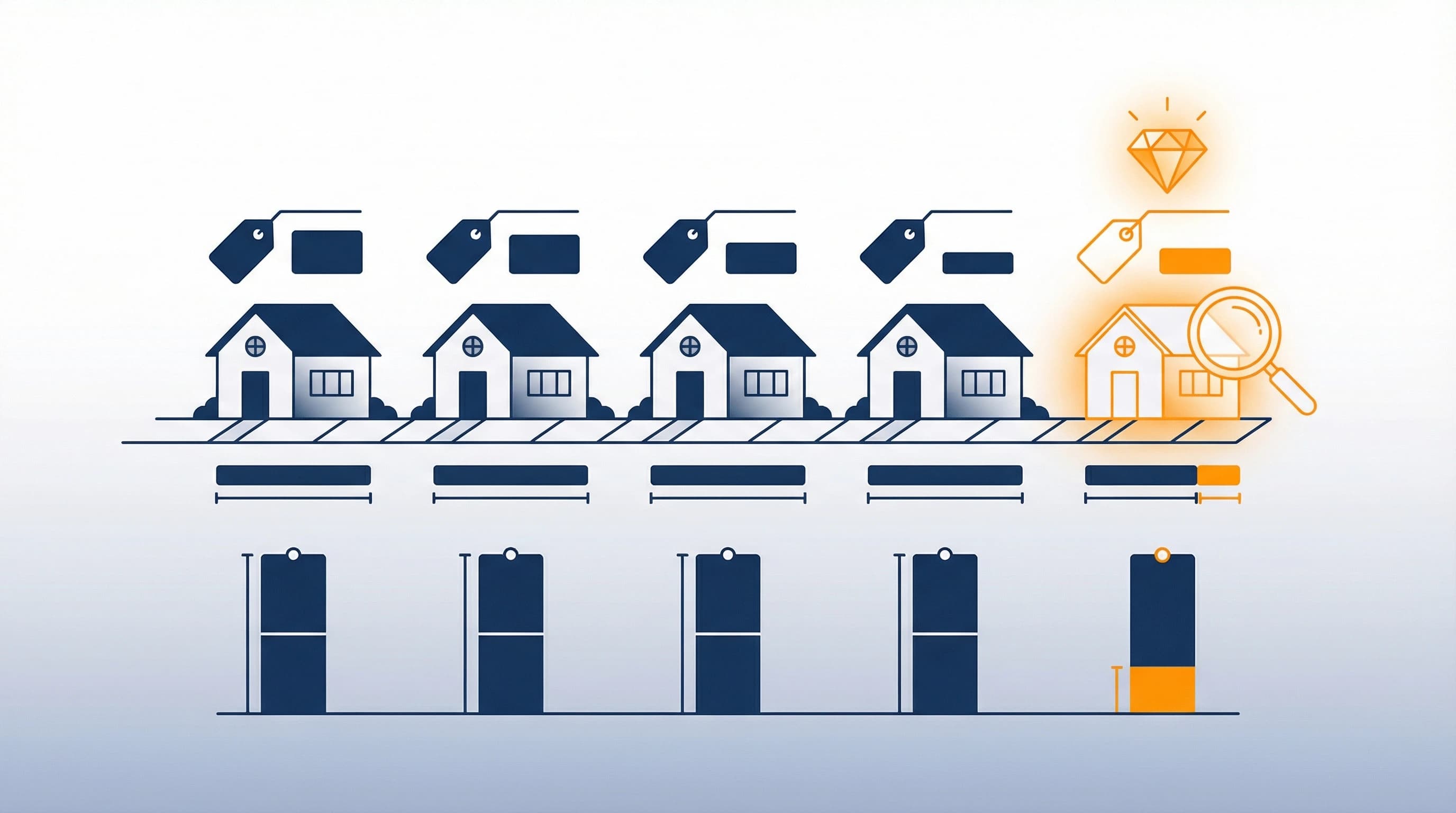
Most property buyers treat the government land valuation as a piece of administrative background data. It shows up on the council rates notice, appears in property reports, and then gets filed and forgotten.
Experienced property researchers use it differently. The government land valuation, when compared systematically against market sale prices across neighbouring properties, can reveal anomalies that point toward genuine undervaluation. It is not a perfect tool, and it should never be used in isolation, but as one component of a structured property research process, it can identify opportunities that casual market analysis would miss.
This article explains the methodology.
A Quick Recap: What the Government Land Valuation Measures
The Queensland Valuer-General's assessed land valuation represents the estimated value of the bare land only, as if no buildings or improvements existed. It is updated annually and applied as at the first of October each year.
The valuation is produced using a mass appraisal methodology, which means it applies statistical modelling across large datasets of comparable land sales rather than individually inspecting each property. This approach is efficient for government purposes but introduces a degree of imprecision at the individual property level, which is exactly where the opportunity lies.
The Land Value Ratio: Your Primary Analytical Tool
The land value ratio is calculated by dividing the government land valuation by the recent total market sale price of a comparable property. The result expresses what proportion of the total market value is represented by the land component.
In an established residential suburb in Brisbane, the land value ratio for a standard house on a standard lot typically falls in a range that reflects the relative age and condition of the dwelling stock, the land size, and the local market's balance between land and improvement value.
For example, if properties in a specific street are consistently selling for $1.2 million, and the government land valuations for those lots average $680,000, the prevailing land value ratio is approximately 57 percent.
A property in the same street selling for $1.05 million with a government land valuation of $720,000 has a land value ratio of approximately 69 percent. This higher ratio suggests either that the improvement on this property is in worse condition than its neighbours (lowering the effective contribution of the building to total value), or that the market price is lower than it should be given the land value, or that the land valuation itself is higher than for comparable lots in the area due to an anomaly.
Each of these explanations suggests a question worth investigating.
Using Surrounding Land Valuations to Benchmark
PropDex due diligence reports include government land valuations for surrounding comparable properties near any subject property. This data layer allows you to benchmark the subject property's land valuation against its neighbours directly.
If a 700 square metre lot at 11 Innes Place has a government land valuation of $640,000 and neighbouring 700 square metre lots on the same street have land valuations of $590,000 to $620,000, the subject property's land is valued approximately 3 to 8 percent higher by the Valuer-General than its comparable neighbours. This premium might reflect a better aspect, a corner position, or improved drainage characteristics. Or it might reflect a modelling anomaly.
Conversely, if a property's land valuation appears systematically lower than its neighbours for no obvious reason, and the market price is similarly lower, there may be a case for the land being underpriced by the market relative to its actual characteristics.
The Land Value to Sale Price Gap
In a rising market, government land valuations sometimes lag behind market movements because the Valuer-General's assessments rely on sales data that trails current market conditions by six to twelve months. When this lag is significant, properties can trade at prices substantially above the government land valuation, which is a normal and expected outcome in strong market conditions.
However, when a property trades at a price that is very close to or below its government land valuation, this warrants investigation. Either the improvement on the property is contributing negative value (a demolition cost, essentially), or the property is selling under distress or in unusual circumstances, or the land valuation itself is out of step with market reality.
Properties trading at or below their government land valuation are relatively rare in established capital city suburbs and may represent opportunities for buyers who understand what is driving the anomaly.
The Limitations of This Approach
The government land valuation as an analytical tool has important limitations that any serious researcher must understand.
The mass appraisal methodology produces averages across comparable properties. For any individual lot, the assessment may be higher or lower than its true market land value by a meaningful margin. Land valuations are not precise enough to support tight quantitative comparisons without additional verification.
The timing lag between the assessment date (1 October) and the current market can produce significant distortions in fast-moving markets. In a suburb where prices have risen 15 percent in the past eight months, the government land valuation assessed before that movement will substantially understate current land values, making all properties in the area appear to have low land value ratios.
Government land valuations do not reflect the presence of easements, contamination, access limitations, or other factors that may discount the effective land value. A property with a government land valuation of $700,000 and a drainage easement running through its usable backyard may genuinely be worth less than a comparable easement-free lot valued at $680,000.
Integrating This Tool Into Your Research Process
The government land valuation analysis works best as a screening tool that generates questions, not as a definitive answer. Use the surrounding property valuation data in a PropDex report to identify any obvious anomalies. Then investigate those anomalies using market sales data, physical inspection, and any relevant planning or title research.
If the anomaly is explained by a physical characteristic (poor condition, easement, planning restriction), adjust your assessment accordingly. If the anomaly has no obvious explanation, the property may genuinely represent undervaluation worth pursuing.
Running a PropDex report at propdextest.com.au before any serious property consideration gives you the surrounding government land valuation data alongside the property's flood risk, easement status, and planning overlays, all of which are relevant to interpreting whether a seemingly low price reflects genuine opportunity or hidden risk.
This article is for informational purposes only and does not constitute financial or investment advice. Government land valuations are an analytical tool, not a definitive measure of market value. Always conduct thorough due diligence and seek independent professional advice.