Overland Flow Flooding: The Development Risk Brisbane Builders Keep Underestimating
Published 20 March 2026
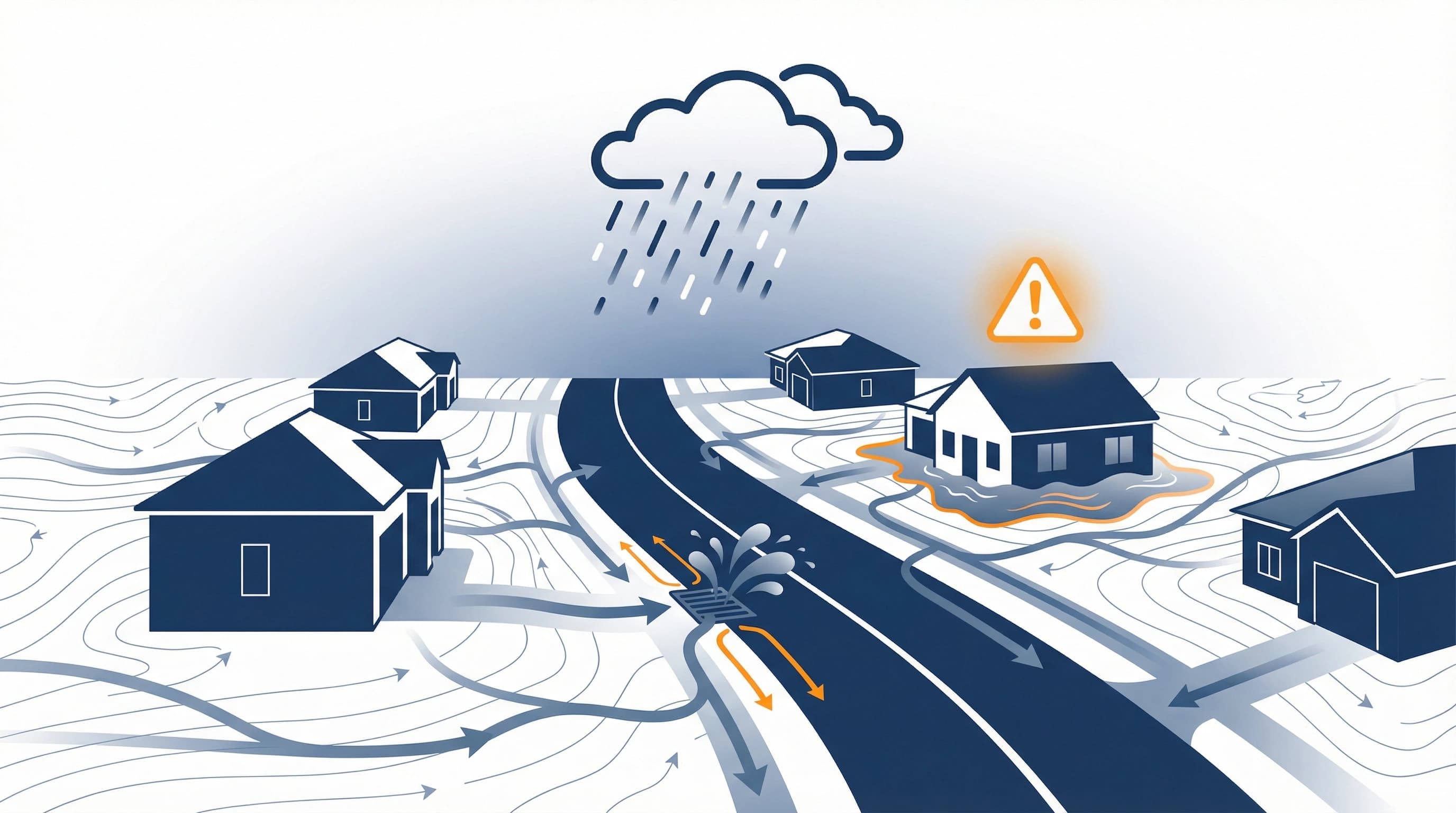
Of the three types of flood risk in Brisbane, overland flow is the least visible and the most frequently underestimated by builders and developers. Unlike Brisbane River flooding, which is clearly tied to a specific geographic feature, or creek flooding, which follows identifiable drainage corridors, overland flow can affect properties anywhere in the urban landscape.
The term refers to the movement of stormwater runoff across land surfaces when the volume of rainfall exceeds the capacity of the underground drainage system to absorb and channel it. During intense rainfall events, stormwater that cannot enter stormwater inlets flows across roads, through yards, and around buildings following the natural and artificial topographic contours of the urban landscape.
Why Overland Flow Is Systematically Underestimated
Several factors combine to make overland flow risk harder to identify and easier to dismiss than riverine flooding.
It is visually less dramatic. Properties affected by overland flow may receive only centimetres of water in most events, whereas riverine flooding can produce metres of inundation. The incremental damage from repeated low-level overland flow events can accumulate significantly over time without producing the dramatic imagery associated with major flood events.
It is less consistently mapped. Brisbane City Council maintains overland flow mapping covering the entire city, published through BCC CityPlan and the Flood Awareness Map. However, the resolution and accuracy of overland flow modelling is inherently more uncertain than riverine flood modelling, because it depends on detailed topographic data and drainage system performance data across a complex urban network.
It is not location-specific in an intuitive way. A property 5 kilometres from the nearest creek can still have significant overland flow risk if it sits at the base of a slope or in a natural drainage path. This disconnection from obvious water features makes it harder for buyers and developers to identify visually.
Development Implications of an Overland Flow Designation
For builders and developers, an overland flow overlay on a site triggers specific assessment requirements under BCC CityPlan.
Development applications affecting sites within the overland flow overlay must demonstrate that the proposed works will not worsen the overland flow situation for neighbouring properties. This may require a site-specific stormwater management report prepared by a civil engineer, demonstrating that post-development runoff from the site is managed to pre-development levels.
For major projects or those near significant flow paths, a more detailed hydraulic assessment may be required. This involves modelling the flow behaviour across the site and demonstrating that the development does not redirect or increase flows onto adjacent properties.
These requirements add to both the cost and the timeline of development applications. A civil engineer's stormwater management report typically costs $2,000 to $8,000 depending on the site complexity. A hydraulic assessment for a more complex scenario can cost $8,000 to $25,000.
The Floor Level Requirement
Properties within overland flow risk areas may face minimum habitable floor level requirements even where the overland flow risk is relatively low. In Brisbane, the specific floor level requirement depends on the applicable flood level determined from the overland flow modelling, plus a freeboard allowance.
For builders and developers, this can mean that a slab-on-ground construction at natural ground level is not achievable. The options are to raise the slab to the required level, to use a suspended floor structure at the required level with the space below used for car parking or storage, or to demonstrate through flood modelling that the site-specific flood level is below the proposed floor level.
The cost of raising floor levels to comply with overland flow requirements can add $10,000 to $30,000 or more to construction costs depending on the site and the required height.
Checking Overland Flow Before You Buy
Both PropDex reports and Brisbane City Council's Flood Awareness Map show the overland flow risk classification (High, Medium, or Low) for any Brisbane property. This check should be one of the first steps in any site assessment for development.
For sites showing Medium or High overland flow risk, the pre-purchase due diligence should include a preliminary discussion with a civil engineer to understand the likely stormwater management requirements and their cost implications before committing to the site.
Visit propdextest.com.au to run a PropDex report as the starting point for any development site assessment in Brisbane.
This article is for informational purposes only and does not constitute legal, financial, or planning advice.