Sewer and Water Infrastructure: Why Proximity Determines Development Feasibility
Published 20 March 2026
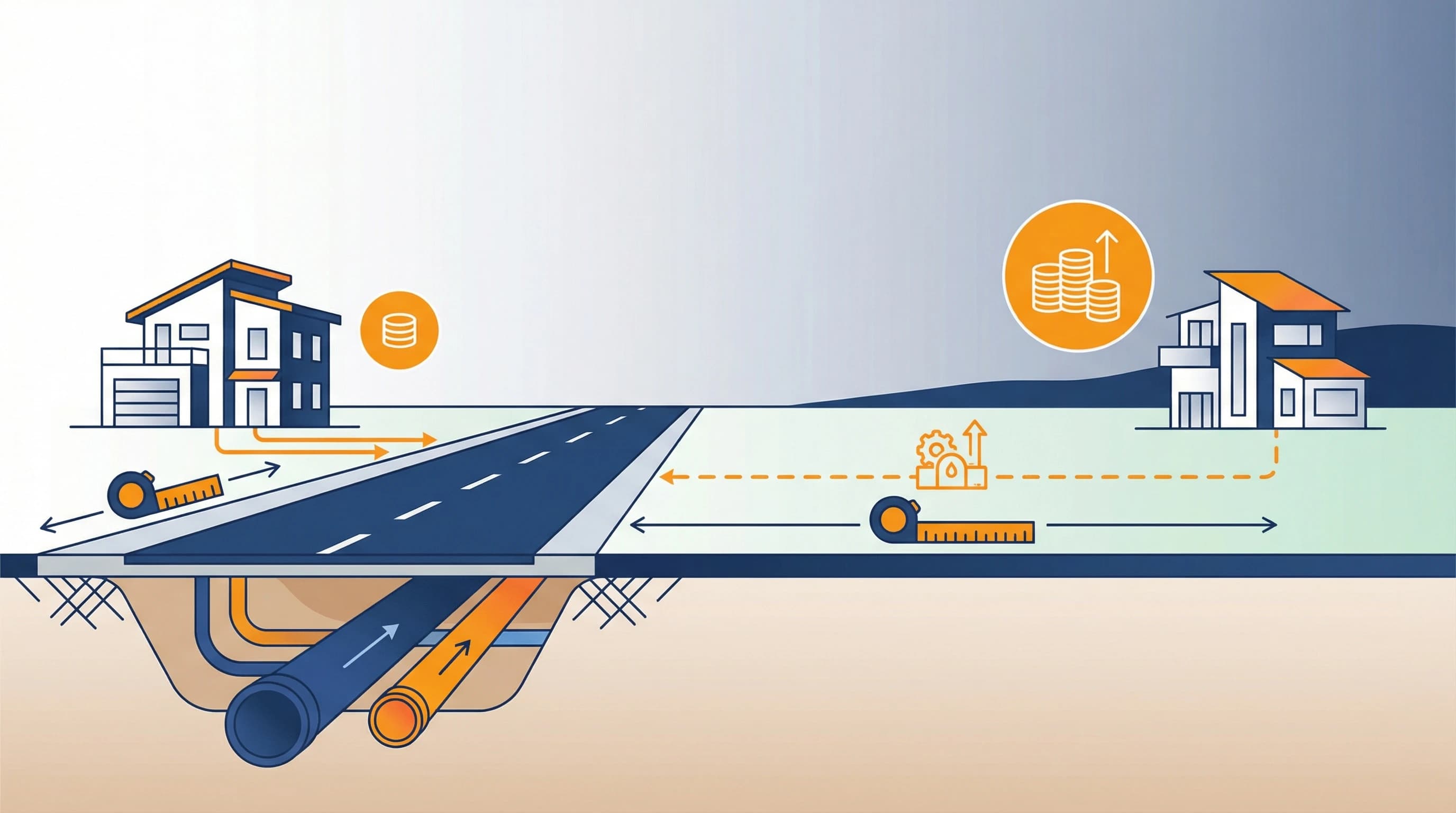
The distance between a development site and the nearest sewer main and water main is one of the most practically important factors in determining whether a development project is financially feasible. Unlike planning approvals, which can often be achieved through good design and negotiation, the physics and engineering economics of connecting infrastructure cannot be redesigned away.
If the sewer main is 300 metres from your proposed development and on the wrong side of a major road, you are looking at either a very expensive connection or a fundamentally different project design. Understanding this before you purchase the site is essential.
Sewer Connection: Gravity vs. Pressure
The standard method for residential sewer connection is a gravity main, which relies on the natural slope of the ground to move sewage from the development to the main sewer network. Gravity connection is low-cost and low-maintenance. It requires that the development can drain by gravity to an existing sewer main at the appropriate depth.
When gravity connection is not achievable (because the main is at insufficient depth relative to the development, or because the distance requires uneconomic trenching), a pressure system (using a pump and rising main) becomes necessary. Pressure systems have higher capital cost (typically $15,000 to $50,000 for a single-lot connection) and ongoing maintenance costs.
For larger developments requiring connection to mains that are distant or require road crossing, the connection cost can run into hundreds of thousands of dollars. Understanding whether gravity connection is feasible before purchasing the site is a critical step in any development feasibility assessment.
Water Mains: Pressure and Location
Water connection requires a connection point to an existing pressure main with adequate pressure and flow to service the proposed development. Most established residential areas in Brisbane have adequate pressure main coverage in adjacent roads. However, for sites in rural residential or fringe areas, the nearest pressure main may be hundreds of metres away, requiring a main extension at the developer's expense.
For multi-lot developments, the water authority (Queensland Urban Utilities for most of Brisbane) will assess whether the existing main has sufficient pressure and flow capacity to service the additional demand. Where upgrades are required, the developer may be required to contribute to or fund those upgrades.
Checking Infrastructure Locations Before Purchase
Brisbane City Council and Queensland Urban Utilities both publish infrastructure mapping data that shows the location of sewer mains, pressure mains, gravity mains, water mains, and manholes. A PropDex due diligence report includes this infrastructure mapping for any Queensland property, showing the relevant sewer and water infrastructure in the surrounding area overlaid on satellite imagery.
This allows a preliminary assessment of connection feasibility before any site is purchased. For development sites where the nearest sewer main appears to be more than approximately 50 to 80 metres away, or where connection would require crossing a major road, engaging a civil engineer for a preliminary connection assessment is a worthwhile pre-purchase investment.
Run a PropDex report at propdextest.com.au to review the sewer and water infrastructure mapping for any development site you are considering.
This article is for informational purposes only and does not constitute legal, financial, or planning advice.