The Suburb Selection Framework: 7 Data Points Every Investor Should Check Before Buying
Published 20 March 2026
Suburb selection is the decision that most determines an investor's long-term outcome. Buy in the right suburb at the wrong time and patience will eventually reward you. Buy in the wrong suburb at the right time and no market cycle will save you from structural underperformance.
The problem is that suburb selection is typically driven by gut feel, proximity to where investors already live, media coverage of recent price movements, or anecdotal recommendations from friends and colleagues. These inputs are not entirely worthless, but they are unreliable as systematic guides to identifying suburbs with genuine long-term investment merit.
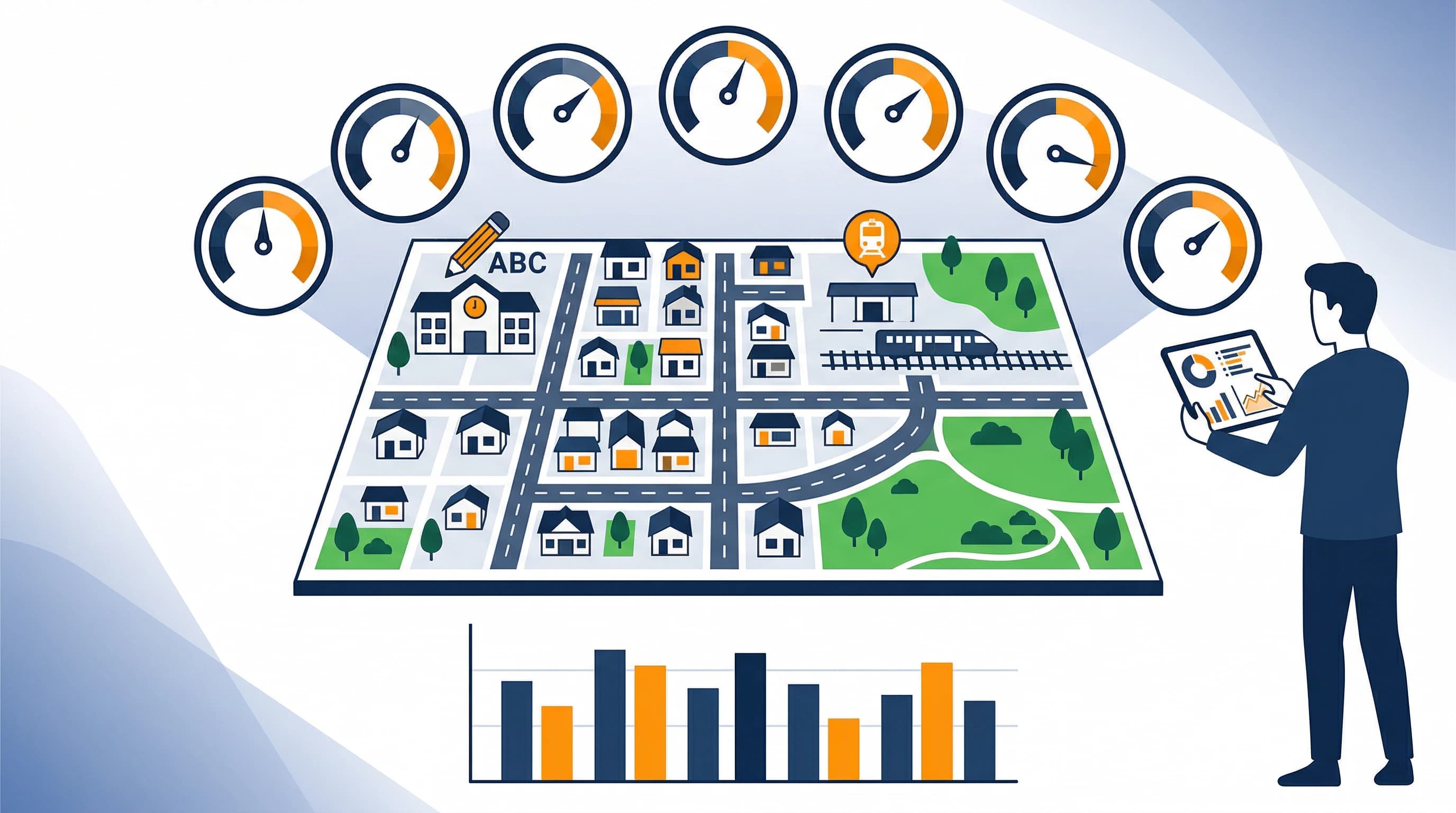
This article presents seven specific data points that experienced property investors use to assess suburb quality before committing capital. These are not complicated metrics. They are publicly available, interpretable without specialist training, and collectively paint a far more reliable picture of a suburb's investment fundamentals than any single indicator alone.
Data Point 1: Owner-Occupier Rate
The proportion of properties in a suburb that are owner-occupied versus rented is one of the most reliable indicators of community stability and long-term capital growth potential.
High owner-occupier rates, typically above 70 percent, indicate that the majority of property purchases in the suburb are driven by people choosing to live there permanently. This produces several investment-positive characteristics. Owner-occupiers maintain their properties more attentively than absentee landlords managing for yield. They participate more actively in the community. They invest in local schools, parks, and streetscape. And they are less likely to sell under distress, which reduces downside volatility in property prices.
The Middle Park suburb in Brisbane, as shown in a PropDex suburb profile, carries an owner-occupier rate of 88.8 percent. This is a very high figure that signals a strongly owner-occupier dominated community. Suburbs with similar profiles in Brisbane include Fig Tree Pocket, Pullenvale, Kenmore, and Ashgrove, all of which have consistently demonstrated strong long-term capital growth relative to higher-rental suburbs.
Owner-occupier data is available from the ABS Census, published every five years. The most recent comprehensive data is from the 2021 Census, though PropDex reports include this data directly.
Data Point 2: School Quality (ICSEA Score)
School quality, measured through the ICSEA (Index of Community Socio-Educational Advantage), is strongly correlated with both property demand and long-term price performance in residential suburbs.
ICSEA is calculated by the Australian Curriculum, Assessment and Reporting Authority (ACARA) based on the socio-educational background of students attending each school, including parental education and occupation levels. The national average is 1,000. Schools with scores above 1,100 are in the top quartile of socio-educational advantage.
For investors, high ICSEA primary schools within the suburb catchment are a proxy for the socio-economic composition of the resident population and the intensity of demand from families prioritising school access. Suburbs with multiple high-ICSEA schools within 2 kilometres consistently command premium prices and attract a buyer pool motivated by long-term lifestyle factors, which supports price resilience.
Middle Park State School carries an ICSEA of 1,070, which is above the national average. Good News Lutheran School, within 0.8 kilometres, carries an ICSEA of 1,181, placing it well into the top national quartile. This school quality concentration is a positive demand signal for the surrounding area.
Data Point 3: Infrastructure Investment Pipeline
Government infrastructure spending is one of the most reliable precursors to property value uplift. New train stations, highway upgrades, hospital expansions, university precincts, and major employment centres shift accessibility and amenity in ways that permanently change the demand profile for surrounding suburbs.
In Queensland, the Brisbane 2032 Olympics infrastructure programme includes upgrades across transport, sporting facilities, and urban renewal precincts across greater Brisbane. The Cross River Rail project, expected to open in 2025-26, introduces new underground stations across the inner city with significant station precinct development expected around each.
Infrastructure investment data is available through the Queensland Treasury Infrastructure Pipeline, the Department of Transport and Main Roads, Brisbane City Council's Major Infrastructure Projects register, and the Brisbane 2032 Games infrastructure announcements.
Investors who identify infrastructure projects in early planning stages, particularly new or upgraded rail stations, before property prices in the surrounding area have fully responded, are positioned for above-market capital growth outcomes.
Data Point 4: Flood Risk Profile
Flood risk directly affects the long-term performance of any property investment through insurance cost, development restrictions, buyer pool limitations, and resale value.
Properties with flood designations face structurally higher holding costs through elevated insurance premiums. Following the 2022 Queensland floods, some properties in high-risk flood zones saw insurance premiums increase by 100 to 300 percent. These cost increases affect net rental yield and cash flow directly.
Beyond the direct cost impact, properties with known flood risk face a narrowed buyer pool at resale. Buyers with full information may discount or avoid flood-prone properties, limiting the competitive tension that drives price appreciation. As flood risk data becomes more accessible through tools like PropDex and government mapping portals, the ability to hide or obscure a property's flood status diminishes.
For residential investment, targeting suburbs and individual properties with clear or low flood designation reduces holding costs, maintains a broad buyer pool at resale, and removes the risk of insurance non-renewal.
A PropDex due diligence report, available at propdextest.com.au, gives you the specific flood overlay status for any property you are considering, covering all three categories of creek, river, and overland flow risk.
Data Point 5: Population Growth Trend
Population growth at the suburb level drives demand for housing, which in turn supports rental demand and price growth. The inverse is also true: suburbs with stagnant or declining populations face weaker housing demand.
Australia's population growth is geographically uneven. Capital cities, particularly those with strong economic fundamentals, attract consistent net migration both from interstate and internationally. Within capital cities, growth patterns are further shaped by infrastructure, lifestyle factors, and housing affordability.
ABS population data, supplemented by Queensland government forecasts from the Department of State Development, Infrastructure, Local Government and Planning, provides the basis for suburb-level population trend analysis. PropDex suburb profiles include 5-year population growth data from ABS Census comparison periods.
Data Point 6: Days on Market and Stock Turnover
Days on market (DOM) and stock turnover are current market health indicators that tell you whether the market for properties in a specific suburb is liquid or slow.
A low median days on market, typically under 30 days in a strong market, indicates properties are selling quickly because buyer demand exceeds supply. This conditions the market for price growth when new stock arrives.
Stock turnover, which measures what percentage of the suburb's total dwelling stock transacts each year, identifies how frequently properties change hands. High turnover indicates active buyer engagement. Very low turnover in a premium suburb can sometimes indicate strong owner loyalty to the area, which can support price stability.
Both metrics are available through real estate data providers and are included in PropDex suburb market snapshots.
Data Point 7: Property Type Mix
The composition of housing types in a suburb affects the overall demand profile and the types of buyers and renters the area attracts.
Suburbs dominated by freestanding houses on land, where houses represent 90 percent or more of the dwelling stock (as is the case in Middle Park at 96.9 percent), attract different buyers to suburbs with significant apartment or unit content. Family buyers prioritise house-dominated suburbs for space, privacy, and school catchment access. This demand profile tends to support stronger long-term capital growth because the underlying supply is constrained by land availability.
Suburbs with high apartment proportions may offer higher rental yields in the short term but often demonstrate more volatile capital growth because apartment supply can expand in response to demand, whereas freestanding house supply is constrained by available land.
Using the Framework in Practice
None of these seven data points provides a definitive answer in isolation. A suburb with a high owner-occupier rate but poor flood risk profile and no infrastructure investment may underperform a suburb with a lower owner-occupier rate but excellent school quality and a new train station under construction.
The framework works by stacking positive indicators and identifying red flags. A suburb that scores strongly on five or six of the seven indicators, with no major red flags on the remaining two, presents a fundamentally stronger investment case than one that is average across all seven.
PropDex reports include many of these data points: flood risk, school quality with ICSEA scores, owner-occupier rates, government land valuations, and nearby amenities. Running a PropDex report on any property you are considering at propdextest.com.au is the most efficient way to access the core data in one place before you begin deeper suburb research.
This article is for informational purposes only and does not constitute financial or investment advice. Property investment carries risk. Always obtain independent financial advice before making investment decisions.