Understanding the Lot/Plan Number on Your Title: What It Means and Why It Matters
Published 20 March 2026
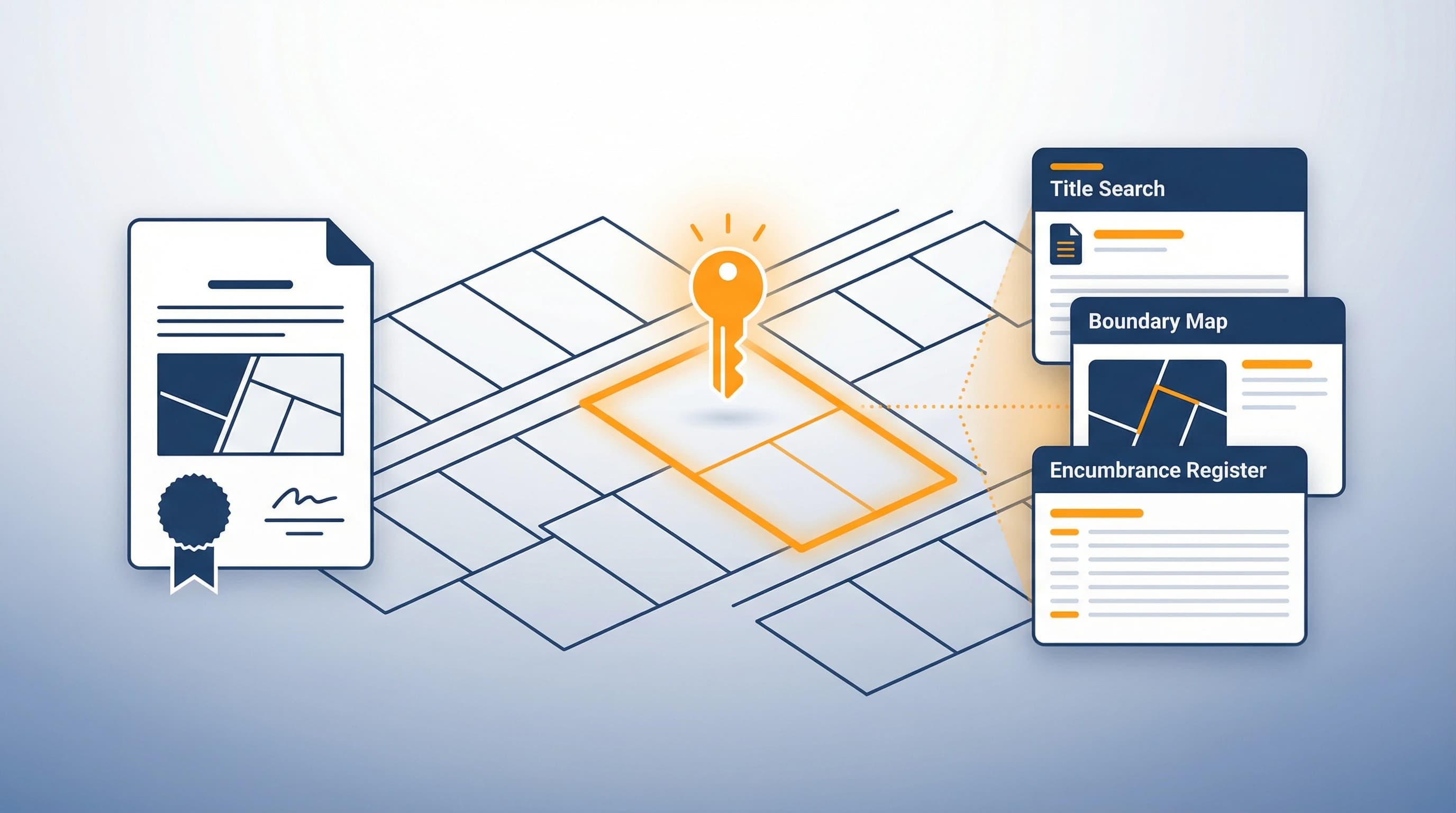
Every piece of land in Queensland has a unique identifier recorded in the land title system. You will see it on contracts, rate notices, search results, and due diligence reports. It looks something like this: 424/RP841166. It is called the Lot/Plan number, and understanding what it means, and how to use it, gives you access to some of the most reliable property information available.
For most buyers, the Lot/Plan number is invisible background noise. It appears on documents they sign without close examination. That is a missed opportunity, because this reference number unlocks access to authoritative title data, cadastral boundaries, registered easements, and the property's legal description, all of which matter in a property purchase.
Breaking Down the Lot/Plan Number
The Lot/Plan number in Queensland consists of two components separated by a forward slash.
The first component is the lot number, which identifies the specific parcel of land within a plan of subdivision. In the example 424/RP841166, the lot number is 424.
The second component is the plan number, which identifies the registered survey plan that created the lot. Survey plans come in several types. RP (Registered Plan) is the most common format for older suburban lots. SP (Standard Format Plan) is used for lots created in more recent standard format subdivisions and for community title schemes such as bodies corporate. BUP (Building Unit Plan) and GTP (Group Titles Plan) apply to older apartment and townhouse schemes.
Together, the Lot/Plan number gives you a precise legal reference that identifies a unique parcel of land within the Queensland title system. No two properties share the same Lot/Plan number.
Why the Lot/Plan Number Matters for Due Diligence
The Lot/Plan number is the key that unlocks formal property searches. When your solicitor or conveyancer orders a title search from the Queensland Land Registry, they use the Lot/Plan number to retrieve the authoritative record for the specific property you are purchasing. That record includes the registered proprietors, any mortgages registered against the property, easements, caveats, and other encumbrances on the title.
It also enables a search of the cadastral database, which is the official record of property boundaries in Queensland. The Queensland Digital Cadastral Database (DCDB) contains the surveyed boundary positions for every lot in the state, including boundary dimensions, area, and the relationship between adjacent lots.
When a property due diligence report refers to the Lot/Plan number, it is drawing on this same dataset to confirm the property's legal identity, area, and boundary configuration.
What the Cadastral Database Tells You About Boundaries
A property boundary is not the fence line. This is one of the most common and costly misunderstandings in property transactions.
Boundary fences may have been erected without reference to the surveyed cadastral boundary. Over decades, fence lines shift, encroach, or are repositioned to reflect informal agreements between neighbours or simply practical convenience. The official legal boundary of the property is the cadastral boundary recorded in the registered survey plan, regardless of where the fence currently sits.
The cadastral database shows the surveyed boundary dimensions and area of each lot. For a property like the one at 11 Innes Place, Middle Park, the Lot/Plan of 424/RP841166 records the lot area of 687 square metres and the surveyed boundary dimensions. The boundary illustration in a PropDex report shows these cadastral boundaries overlaid on satellite imagery, which immediately reveals any significant discrepancies between fence lines and legal boundaries.
Common boundary issues that buyers encounter include the following.
Encroachments occur when a structure built by a neighbouring owner crosses the legal boundary. A garage wall, garden shed, retaining wall, or even a house corner constructed on or over the boundary creates an encroachment that can affect both properties and may require legal resolution.
Adverse possession claims can arise in rare circumstances where a neighbour has occupied and used a portion of land for an extended period in a way that could potentially ground a claim to title. These situations are uncommon but real.
Boundary disputes arise when neighbours disagree about where the legal boundary falls. They are almost always more expensive and time-consuming to resolve than the initial identification of the issue would have been.
Variation from title area occurs when the cadastral records show a lot area that differs from what is stated in the contract or marketing material. While minor variations are common, significant discrepancies warrant investigation.
How to Check Cadastral Boundaries Before You Buy
You have several options for checking cadastral boundaries before committing to a purchase.
The free option is to use Queensland's Spatial Cadastre viewer, available through QSpatial, which shows cadastral boundary positions across the state. This is the same dataset used by PropDex and other due diligence tools. It provides a visual check of boundary positions that can reveal obvious discrepancies.
For a more authoritative view, a registered surveyor can conduct a boundary identification survey. This involves physically locating the surveyed boundary pegs and confirming their positions. It is the only way to definitively establish where the legal boundary sits on the ground. Costs typically range from $1,500 to $4,000 depending on lot size and complexity.
A PropDex property report includes a cadastral boundary overlay showing the official lot boundary from the Queensland Digital Cadastral Database, with boundary dimensions, positioned over current satellite imagery. This gives you an immediate visual reference for the legal boundary position relative to existing fences and structures. It is an excellent first-line check that costs a fraction of a formal survey.
When to Commission a Formal Boundary Survey
Most standard residential purchases do not require a formal boundary survey, particularly for established properties in developed suburbs where clear cadastral records exist and boundary disputes are not anticipated.
However, a formal survey is worth considering in the following circumstances.
When boundary discrepancies are visually apparent. If the PropDex cadastral overlay or your own visual inspection suggests fence lines are significantly misaligned with legal boundaries, a survey clarifies the position.
When development plans depend on boundary positions. If you intend to build close to a boundary, install a pool, or construct any structure where the available space is critical, knowing the exact boundary position is a prerequisite for design and certification.
When the seller claims a different area than the title records. If the marketing material quotes a land area that differs from the cadastral record, a survey resolves the discrepancy before you are committed.
When a neighbouring dispute is in progress or has recently been resolved. A survey establishes a definitive record that can prevent future disagreement.
Searching the Title Yourself
You do not need a solicitor to conduct an initial title search in Queensland. The Queensland Land Registry offers a self-service search facility through the Titles Queensland portal where individual title documents can be purchased for a small fee, typically around $16 to $25 per document.
From this search, you can obtain the current title deed, which shows the registered proprietors, any mortgages (technically called "registered interests"), easements, and encumbrances registered against the lot. This is publicly available information and represents your first authoritative check of the property's legal status.
Your solicitor will conduct a more comprehensive search that may include additional records. However, an initial self-service search is a useful pre-offer step that costs very little and can reveal issues worth addressing before you invest further time and money in the process.
Putting It All Together
The Lot/Plan number on your property title is not bureaucratic noise. It is the key to the authoritative legal record of the property you are considering purchasing.
Using that number to access cadastral boundary data, title searches, and comprehensive due diligence information is not optional for a buyer who wants to make an informed decision. It is foundational.
A PropDex report uses the Lot/Plan number to pull the relevant cadastral boundary data and present it clearly alongside all other relevant due diligence information. Before you make an offer on any Queensland property, visiting propdextest.com.au and generating a PropDex report gives you the boundary picture, the flood risk status, the easement information, and the broader property profile in a single document you can review before you commit.
This article is for informational purposes only and does not constitute legal advice. For any complex boundary, title, or planning issues, engage a qualified solicitor, conveyancer, or registered surveyor as appropriate to your circumstances.