Vegetation Management Act Queensland: What Developers Must Know Before Clearing Land
Published 20 March 2026
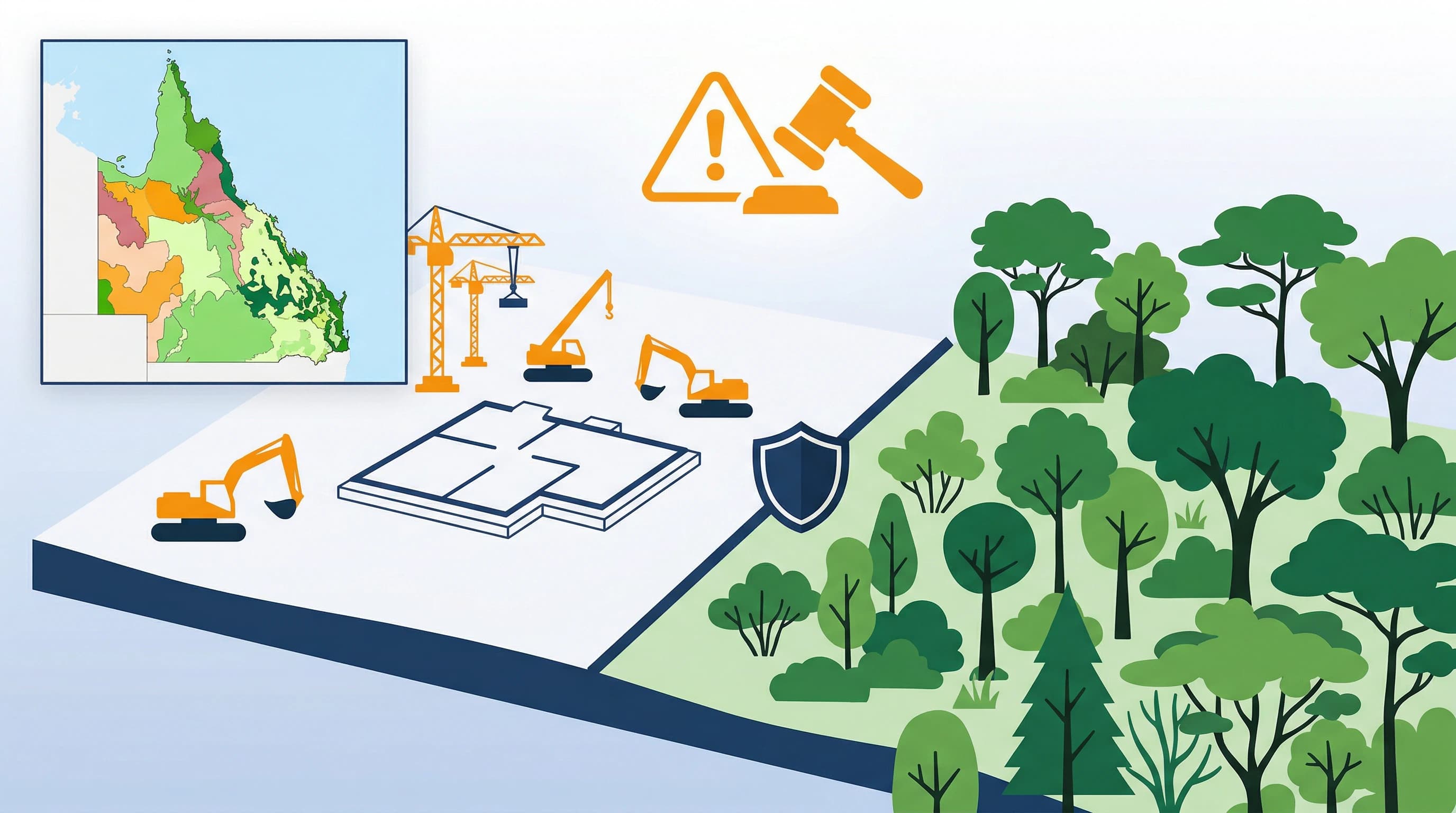
Queensland's Vegetation Management Act 1999 regulates the clearing of native vegetation across the state and imposes significant obligations on landowners and developers who propose to remove or disturb regulated vegetation. Getting this wrong carries substantial penalties, including fines of up to $2.87 million and enforceable undertakings requiring revegetation at the offender's expense.
Understanding whether regulated vegetation exists on a site, and what obligations apply before any clearing commences, is an essential step in any development feasibility assessment.
The Vegetation Category Framework
Queensland's vegetation management framework classifies land according to the type and status of vegetation present. The categories directly relevant to development are as follows.
Category A is the most protected category, covering vegetation of high conservation significance. Clearing Category A vegetation requires an offset, meaning equivalent vegetation must be protected, restored, or enhanced elsewhere. In most circumstances, clearing Category A vegetation is subject to very strict conditions or is not achievable in a way that is financially viable for typical development projects.
Category B covers remnant vegetation that is not Category A. Clearing may be assessable under the Vegetation Management Act and may require a development permit.
Category C covers high-value regrowth vegetation that has developed since clearing occurred. Category C has specific provisions that depend on the date of regrowth and the location.
Category R covers watercourse vegetation in Great Barrier Reef catchment areas.
Category X covers land that is not regulated under the vegetation management framework and can generally be cleared without vegetation management approvals. Most established urban residential land falls into Category X, which is why individual suburban property owners can typically remove garden trees and vegetation without vegetation management approvals (subject to council tree management policies).
How to Identify the Vegetation Category for a Development Site
The Queensland Department of Resources maintains the State's vegetation mapping, which is publicly accessible through QSpatial and through the Queensland Globe mapping portal. These systems show the vegetation category applicable to any Queensland property.
A PropDex due diligence report includes a vegetation management layer showing whether regulated vegetation has been identified for the subject property. The Environmental Values section of the report also flags regulated vegetation status with a clear/found indicator.
For development sites in fringe and rural residential areas where Category A, B, or C vegetation may be present, reviewing the vegetation management layer is a critical step before any clearing, earthworks, or development application proceeds.
Penalties and Compliance
Unlawful clearing of regulated vegetation carries serious consequences. The Queensland Department of Environment and Science undertakes remote sensing monitoring of vegetation across the state and investigates clearing events identified through satellite imagery analysis. The ability to detect even small-scale clearing remotely means that the risk of detection for unlawful clearing is significant.
Beyond financial penalties, a court can order the restoration of cleared vegetation at the responsible party's expense. This can be extraordinarily expensive, particularly for large-scale or ecologically sensitive clearing events.
Getting It Right: The Permit Pathway
Where regulated vegetation is present on a development site and clearing is necessary or desirable for the project, the correct pathway is to apply for a vegetation clearing permit from the relevant authority. The application requirements vary depending on the category of vegetation and the nature of the proposed clearing, but typically include a site assessment by a qualified ecologist, a description of the proposed clearing, and details of any proposed offsets.
Engaging a qualified environmental consultant early in the site assessment process, before committing to purchase, gives you a reliable assessment of whether the vegetation management requirements are manageable within the project's financial parameters.
This article is for informational purposes only and does not constitute legal, financial, or planning advice.